
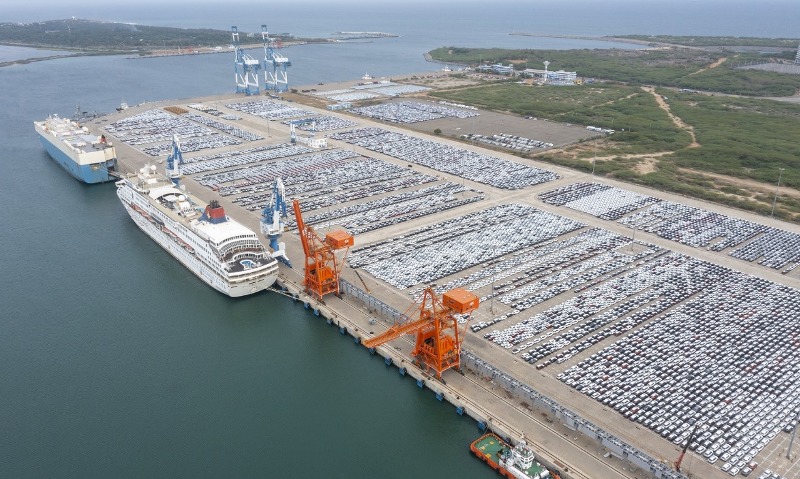
Hambantota International Port (HIP) has recorded a major upswing in cargo volumes, surpassing 6 million metric tons by September 2025 — a 151% surge compared to the same period last year. The sharp rise reflects the port’s growing capacity and expanding role as a multipurpose maritime hub, with strong performance across container handling, liquid bulk, bunkering, and vehicle transshipment.
The port recently concluded a significant infrastructure upgrade, investing USD 41 million in new equipment that includes four high-performance quay cranes and thirteen rubber-tyred gantry cranes. With these additions, HIP has boosted its annual container handling capacity to 1 million TEUs. The new cranes, equipped with advanced automation and anti-collision features, offer enhanced efficiency, with quay cranes capable of twin-lift operations of up to 75 tons and gantry cranes supporting loads of up to 41 tons for faster container stacking and retrieval.
HIP is also seeing robust growth beyond container operations. LPG throughput has nearly doubled year-on-year, bunker fuel sales have risen sharply, and vehicle transshipment continues to expand, supported by rising regional demand. This diversified growth underscores the port’s ambition to strengthen its position as a comprehensive logistics hub capable of serving a wide spectrum of maritime activity.
The surge in cargo volumes has brought operational challenges, particularly congestion driven by increased vehicle imports. In response, HIP has refined yard allocation, adjusted stacking strategies, and expanded its workforce to sustain smooth vessel-handling operations.
Strategically located along the busy Indian Ocean shipping lanes, Hambantota Port’s ongoing expansion and modernization have positioned it to compete more effectively with major regional ports, strengthening Sri Lanka’s role in global maritime trade.