
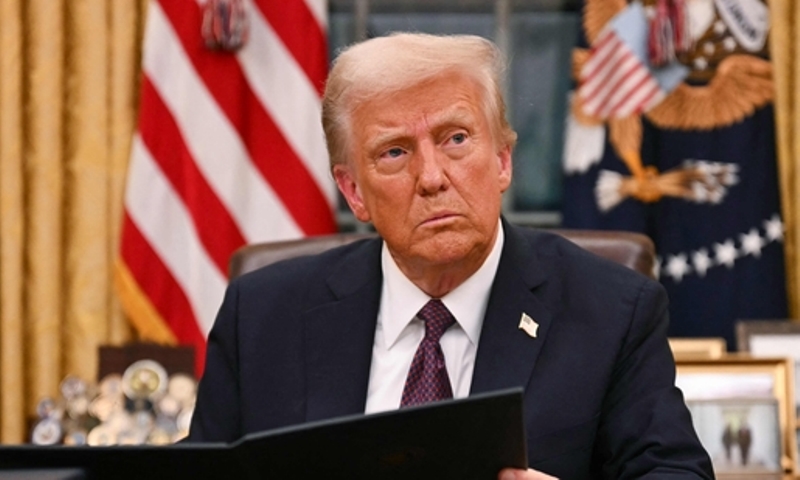
US President Donald Trump has indicated that the US-Israel war on Iran is “militarily, effectively over”, signalling that the conflict could come to an end soon as diplomatic efforts intensify following talks with Qatar’s Prime Minister Mohammed bin Abdulrahman bin Jassim Al Thani at the White House.
Speaking to reporters in Washington, DC, on Monday, November 9, Trump said further military action against Iran did not appear necessary at present, although the United States remained prepared to resume operations if circumstances changed.
“At this point… taking military action doesn’t seem to be a very necessary thing, but we’re locked and loaded, ready to go for any reason that changes,” Trump said, adding that momentum was building towards ending the conflict.
Trump made the remarks after hosting Sheikh Mohammed alongside Vice President JD Vance for discussions on the Iran war and efforts to advance negotiations between Washington and Tehran.
Following the meeting, the Qatari prime minister said on social media that discussions had focused on the regional situation and ways to advance US-Iran talks. He expressed optimism about the discussions, saying they were positive steps towards reaching an agreement and restoring peace in the region.
Trump claimed that the US had significantly weakened Iran’s military capabilities and said the conflict was effectively over from a military standpoint. However, he indicated that Washington intended to maintain the existing pressure on Tehran rather than immediately declaring a formal end to hostilities.
US to Continue Naval Blockade and Trade Restrictions
A key element of Washington’s current approach is the continuation of its naval blockade against Iranian ports, alongside the newly announced Task Force Iron Gate, which aims to restrict Iran’s trade routes by land and through the Caspian Sea.
Trump described the blockade as one of the most extensive in US history, claiming that several Gulf countries, including Qatar, Saudi Arabia, the UAE, Bahrain and Kuwait, preferred maintaining the current arrangements.
He also stressed the need for a long-term settlement rather than a temporary ceasefire, while declining to guarantee that a lasting agreement would be reached.
“We have some great allies there, and we have to make sure they’re not hurt,” Trump said, arguing that regional security had improved following the weakening of Iran’s military capabilities.
Iran Rejects US Claims, Remains Open to Negotiations
Iranian officials have dismissed Trump’s latest remarks, questioning Washington’s claims about the progress of diplomatic negotiations.
Mohsen Rezaei, Secretary of Iran’s Supreme National Security Council, criticised the US administration in a social media post, describing its statements about negotiations as an attempt to manufacture misleading narratives.
Meanwhile, Iranian President Masoud Pezeshkian said Supreme Leader Mojtaba Khamenei had called for an end to the current situation of neither war nor peace.
Pezeshkian indicated that Tehran remained open to negotiations but would not accept an agreement imposed through military or economic pressure.
“We will not surrender to force and bullying,” he said, according to Iranian media reports.
Iran has reportedly put forward seven conditions for ending the conflict. These include lifting the US naval blockade, compensation for war-related damage, removal of economic sanctions and an end to hostilities across all fronts, including Lebanon and Gaza.
Qatar Steps Up Mediation Efforts
Qatar has emerged as one of the principal intermediaries between Washington and Tehran, using its diplomatic channels to facilitate discussions aimed at ending the conflict.
Sheikh Mohammed, who also serves as Qatar’s foreign minister, reportedly presented Trump with a two-day framework proposed by Iran for ending the war during Monday’s closed-door meeting.
The discussions come amid renewed diplomatic activity following months of intermittent military exchanges and mounting economic disruption across the Middle East.
Conflict Continues to Disrupt Regional Trade and Shipping
The war, which began on February 28, has had far-reaching consequences for regional security, international shipping and global trade.
One of the most significant developments has been Iran’s move to disrupt traffic through the Strait of Hormuz, a strategic maritime corridor through which substantial volumes of global oil, natural gas and fertiliser shipments move.
The conflict has also drawn in several Gulf countries, including Qatar, Bahrain, Kuwait and the UAE, following Iranian missile and drone attacks on targets in the region, including US military installations.
The wider regional crisis has been compounded by renewed fighting involving Saudi Arabia and Iran-backed Houthi forces, as well as Israeli military operations in southern Lebanon.
Although US military operations against Iran have become intermittent, tensions have persisted. The Trump administration recently confirmed further limited strikes against Iran’s Qeshm Island.
Washington has also announced a $20 million reward for information relating to Iran’s nuclear programme, including facilities, equipment and personnel.
Iran’s nuclear programme remains a central point of disagreement. While Trump has repeatedly maintained that Iran’s nuclear capabilities must be dismantled, Tehran continues to deny seeking nuclear weapons, insisting that its uranium enrichment activities are intended for civilian energy purposes.
Despite Trump’s assessment that the war is effectively over militarily, the continued naval blockade, unresolved nuclear concerns and disagreements over sanctions and regional security indicate that a comprehensive settlement remains uncertain.
For the global maritime and logistics industry, any sustained de-escalation could be significant, particularly if it leads to the restoration of normal shipping movements through the Strait of Hormuz, easing pressure on energy supplies, freight costs and regional trade flows.