
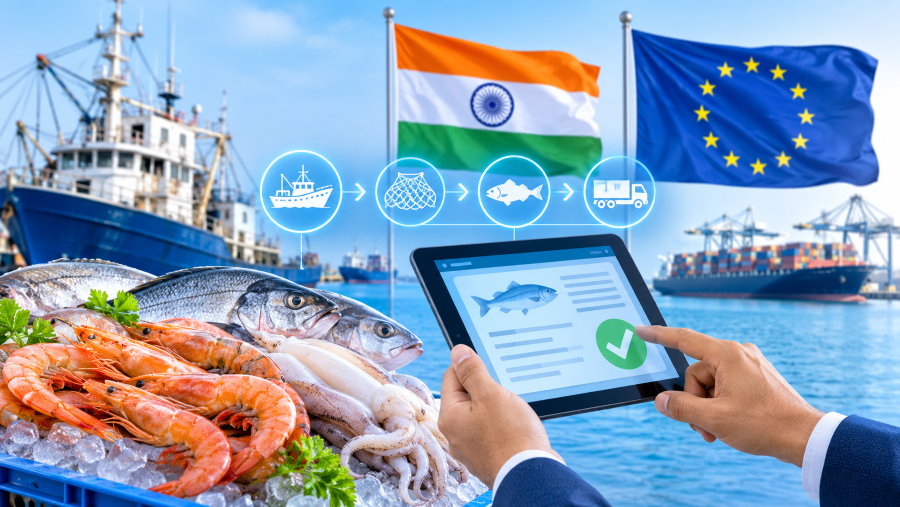
The Marine Products Export Development Authority (MPEDA) has launched a new digital catch certification and traceability system to help India’s seafood exporters comply with the amended European Union (EU) regulations governing imports of wild-caught marine products.
The initiative aims to strengthen traceability across the seafood supply chain by enabling the digital capture of primary catch-related information and integrating it with MPEDA’s existing online catch certificate validation portal.
According to Manoj Kumar TG, Deputy Director, MPEDA, Mangaluru, the EU has mandated catch certificates for wild-caught marine products since January 2010 as part of its efforts to prevent illegal, unreported and unregulated (IUU) fishing. Authorised by the Government of India to validate these certificates, MPEDA introduced online validation in 2010 and subsequently moved to digital signature-based validation in April 2019.
The amended EU regulations, which came into effect on January 10, 2026, require additional information in catch certificates, including the fishing gear used, details of the vessel’s master or fishing licence holder, voyage particulars and the validity of the fishing licence.
To facilitate compliance, MPEDA has enabled private agencies to develop digital applications for capturing primary traceability data. The information collected through these applications will be integrated with the existing online catch certificate portal for verification and validation.
Catch certificates are mandatory documents that must accompany consignments of wild-caught marine products exported to the EU. Similar requirements are also being followed by the United Kingdom following its exit from the EU.
The initiative assumes significance given the importance of the European market to India’s seafood export sector. During 2025–26, India exported 2,97,518 tonnes of marine products worth USD 1.6 billion (₹13,935 crore) to the EU, including the UK. These shipments accounted for 15% of India’s total seafood export volume and 18.8% of its export earnings.
Major products exported to the region included frozen shrimp, cuttlefish, squid, fish oil, fishmeal and surimi. Wild-caught marine products constituted 16% of India’s seafood exports to the EU by volume and 27% by value.
The new digital system is expected to improve data transparency, strengthen supply-chain traceability and support Indian seafood exporters in meeting evolving international regulatory requirements, particularly those aimed at eliminating IUU fishing.