
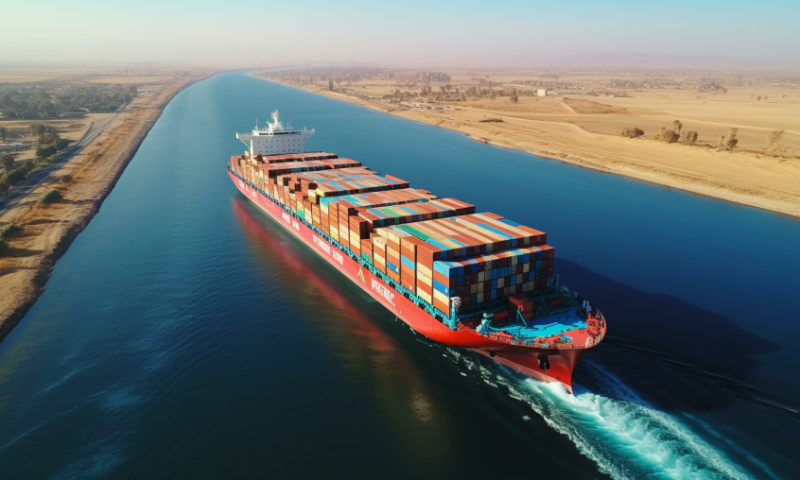
The accelerating return of container shipping services to the Suez Canal and Red Sea is raising concerns over potential congestion at key regional ports, as shipping lines increasingly restore shorter Asia–Europe routes.
Taiwanese shipping major Evergreen is planning eight ad hoc transits through the Suez Canal and Bab el-Mandeb Strait for its Far East–Europe services, alongside four sailings specifically targeting the Red Sea market, according to Alphaliner.
The 16,556 TEU Ever Eon recently completed its first Suez Canal transit while sailing from Rotterdam to Singapore on the Ocean Alliance’s China Europe Shuttle (CES) service. Three more eastbound transits are planned this year, while another vessel is scheduled for a westbound passage in December.
Evergreen is also preparing to restore direct connections between the Far East and Red Sea through its OGRD service, deploying vessels ranging from 7,024 to 9,466 TEU. The service will cover Jeddah in Saudi Arabia, Sokhna in Egypt and Aqaba in Jordan, with its first sailing scheduled to depart Qingdao on November 14.
Meanwhile, Emirates Shipping Line is introducing a fortnightly Central and South China–Red Sea service, connecting Shanghai, Ningbo and Nansha with the same three Red Sea ports. The service will operate with three vessels ranging from 2,500 to 4,900 TEU, with its inaugural sailing scheduled for November 13.
The overlapping service networks could concentrate additional container volumes at selected Red Sea gateways, potentially placing pressure on terminal infrastructure and landside operations.
Jeddah is already experiencing significant growth in container traffic. DP World’s South Container Terminal handled more than 221,200 TEU in July, its highest monthly throughput since operations began in 1999. The terminal recorded a 79% year-on-year increase in volumes during the first half of the year.
Despite investments in additional cargo-handling equipment and capacity expansion, operational challenges remain. Expeditors reported congestion at Jeddah in September, with landside delays extending to 10–12 days following container discharge. The arrival of additional services could further test the port’s operational capacity.
At the same time, ports receiving fewer direct vessel calls could face the risk of losing cargo volumes and terminal utilisation as shipping lines consolidate their networks around selected gateways.
Congestion risks extend to European ports
The impact of the return to Suez is not expected to be confined to the Red Sea. The transition could also create congestion at major North European ports as vessels using the shorter Suez route arrive earlier and potentially coincide with ships that are still travelling around the Cape of Good Hope.
Maersk and Hapag-Lloyd have confirmed the return of their ME1 service to the Suez Canal, joining six other Gemini Cooperation services already using the shorter route.
According to Flexport’s November European freight market update, vessel capacity scheduled to arrive at European ports is forecast to reach 131% of normal levels in Week 47. Around 40% of this capacity is expected to arrive through Suez, including 31 containerships, while another 61 vessels are scheduled to arrive via the Cape of Good Hope.
Flexport considers arrivals exceeding 120% of normal capacity a potential congestion risk. Its projections indicate that this threshold could be breached in at least three weeks between mid-November and January.
Rotterdam is already facing operational pressure, with average container dwell times reaching 3.37 days in Week 42 and yard utilisation ranging between 80% and 90%.
While the return to Suez could reduce Asia–Europe sailing times by approximately seven to ten days, the rapid transition risks shifting congestion between ports rather than eliminating delays across the global supply chain.
The developments highlight the operational challenges facing shipping lines, port operators and logistics providers as global container networks gradually adjust to the resumption of Red Sea and Suez Canal services.