
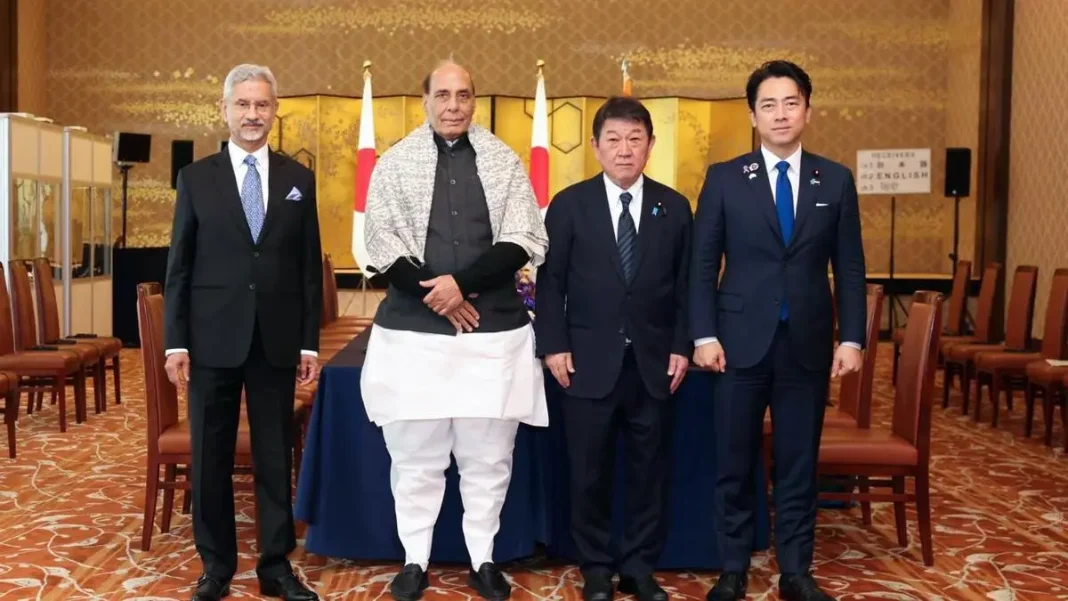
India and Japan have expressed serious concerns over economic coercion, arbitrary export restrictions and non-market trade practices that disrupt global supply chains, reaffirming their commitment to strengthening economic security and strategic cooperation.
The concerns were highlighted during the fourth India-Japan 2+2 Foreign and Defence Ministerial Dialogue held in Tokyo on November 19, attended by India’s External Affairs Minister S. Jaishankar and Defence Minister Rajnath Singh, along with their Japanese counterparts, Foreign Minister Toshimitsu Motegi and Defence Minister Shinjiro Koizumi.
In a joint statement issued after the meeting, both countries expressed grave concern over economic coercion, including arbitrary export restrictions and non-market policies and practices that create excess capacity and disrupt global supply chains in critical industries. Although no country was specifically named, the statement reflects growing concerns over vulnerabilities in international trade and supply chains.
External Affairs Minister S. Jaishankar highlighted the increasing tendency to weaponise resources, connectivity, services, supply chains and market access, noting that such developments have direct implications for national security. He stressed the importance of strengthening resilience and exploring alternative supply chain options amid growing global uncertainties.
The two countries agreed to deepen cooperation in strategic sectors, including semiconductors, critical minerals, information and communication technology, clean energy and pharmaceuticals. They also called for greater engagement between governments, industries and research institutions to diversify supply chains and reduce strategic vulnerabilities.
Highlighting the importance of maritime connectivity, Jaishankar stressed that ensuring the smooth functioning of maritime trade is essential to international commerce, particularly amid growing geopolitical uncertainties and disruptions affecting critical trade routes.
The dialogue also focused on strengthening defence and maritime security cooperation, including collaboration in underwater and missile technologies, maritime domain awareness, information sharing, search and rescue operations and naval shipbuilding.
India and Japan reiterated their commitment to maintaining a free, open and rules-based Indo-Pacific region, recognising the importance of secure sea lanes and resilient supply chains for regional stability and global economic growth.
The two sides also reaffirmed their support for a fair and competitive global economic environment and agreed to pursue practical cooperation to strengthen supply chain resilience across critical industries.