
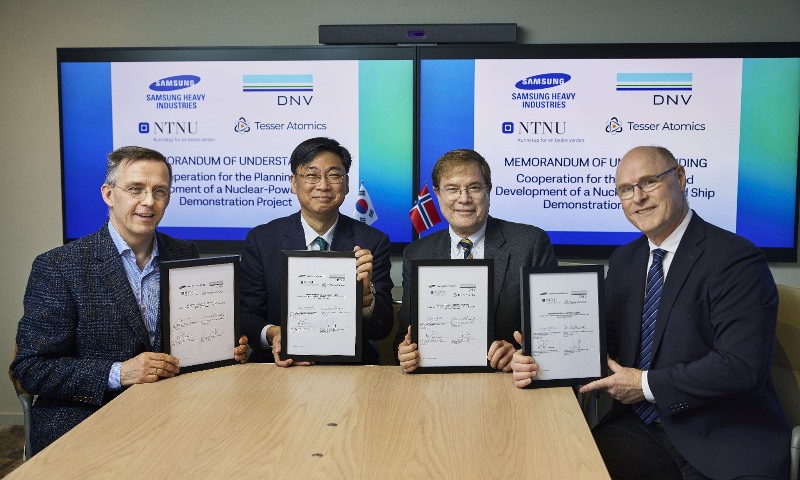
Samsung Heavy Industries Co., Ltd. (SHI), Tesser Atomics, the Norwegian University of Science and Technology (NTNU) and DNV have signed a Memorandum of Understanding (MoU) to collaborate on the development of a nuclear-powered LNG carrier demonstration project.
The agreement was signed during a collaborative workshop at DNV’s headquarters in Høvik, Norway, bringing together expertise in shipbuilding, nuclear reactor technology, maritime safety and academic research.
Under the agreement, the partners will develop a conceptual design for a nuclear-powered LNG carrier intended to operate between LNG terminals in the United States and Europe. The initial phase will focus on establishing a roadmap covering the demonstration vessel concept, safety assessments and regulatory approvals, with the ultimate objective of identifying a practical commercial pathway for the ship’s design, construction and commissioning.
The vessel concept will incorporate Tesser Atomics’ marinised fluoride-salt-cooled reactor technology and will serve as a reference project for SFI SAINT, Norway’s nuclear-powered vessel research centre. The initiative will be one of several demonstration projects undertaken in coordination with the NTNU-led SFI SAINT centre.
Partners to Lead Key Development Areas
Under the collaboration, Samsung Heavy Industries will lead vessel concept development and marine integration, focusing on shipbuilding feasibility and construction methods. Tesser Atomics will take responsibility for reactor technology and nuclear plant development, including reactor-specific safety and licensing activities.
DNV will contribute its expertise in maritime safety, risk assessment and classification. Its responsibilities will include hazard identification, developing a safety assessment framework and establishing a classification and verification roadmap.
NTNU will coordinate research activities, funding proposals and consortium development, while supporting feasibility studies, simulations, modelling and testing.
Industry Leaders Highlight Commercial Potential
Kyunghee Kim, Executive Vice President and Head of the Future Business Division at Samsung Heavy Industries, said nuclear-powered vessels represent a promising eco-friendly alternative for maritime transportation amid the global push towards decarbonisation. He added that the company would build on its experience in marine small modular reactor (SMR) technology to advance the commercialisation of nuclear-powered vessels alongside its partners.
Dr. Per Peterson, Co-Founder and CEO of Tesser Atomics, highlighted the importance of collaboration with the Norwegian SFI SAINT consortium in addressing the legal, regulatory and insurance requirements associated with deploying a nuclear-powered demonstration vessel. He also noted that the partnership with Samsung Heavy Industries would bring world-class ship design and construction capabilities to the project.
Ivar Håberg, Director of Approval Ship Classification at DNV, described the initiative as an important step towards developing the first modern full-scale nuclear-powered cargo vessel. He noted that although nuclear propulsion has a long history in naval applications, it has yet to make the transition into the commercial shipping sector.
Prof. Hans Petter Hildre, Chair of the NTNU Department of Ocean Operations and Civil Engineering, said Norway’s maritime innovation history and experience in nuclear safety would support the development of commercial nuclear propulsion. He also pointed to the country’s established safety review process for visits by nuclear-powered naval vessels to Norwegian ports.
Potential Beyond LNG Carriers
The partners aim to establish a technically feasible and commercially viable vessel concept through the collaboration. While the initial focus is on an LNG carrier operating between the United States and Europe, the underlying design could potentially be adapted for other vessel segments, including container ships.
The project represents another significant development in the exploration of nuclear propulsion as a potential solution for reducing emissions from long-distance maritime transportation. Its progress will depend on addressing technical feasibility, safety, regulatory approval, licensing and commercial considerations before a demonstration vessel can move towards construction.