
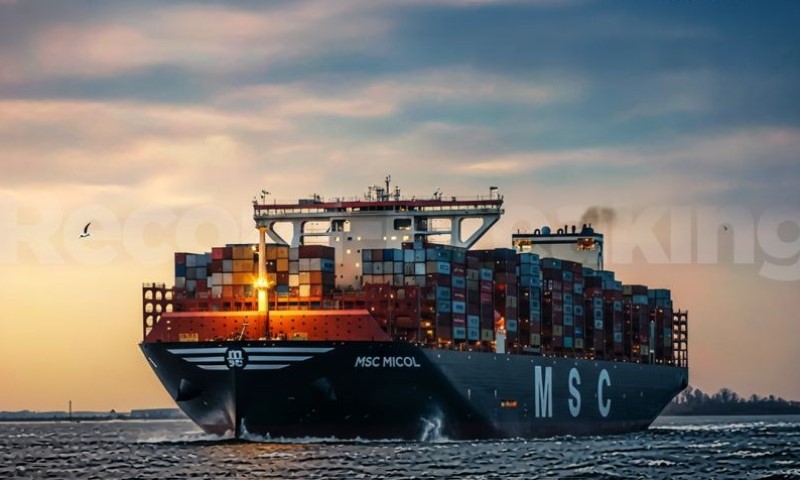
Maersk, Mediterranean Shipping Company (MSC) and South Korea’s HMM are stepping up investments in new container vessels, accounting for nearly 80% of the capacity covered by recently reported containership orders, according to shipping consultancy Dynamar’s November 2026 edition of DynaLiners Monthly.
The report identifies 83 new containership orders with a combined capacity of 938,500 TEUs, excluding two additional vessel options. The vessels are scheduled for delivery between 2028 and 2031, highlighting the scale of fleet expansion planned by major shipping companies over the coming years.
The three carriers account for 35 vessels with a combined capacity of 746,200 TEUs, representing approximately 79.5% of the total capacity covered by the reported orders.
Maersk leads newbuilding investment
Maersk accounts for the largest share of the reported orders, with 24 containerships of 24,000 TEUs each placed with China’s Hudong-Zhonghua Shipbuilding.
The vessels, representing a combined capacity of 576,000 TEUs, are scheduled for delivery in 2029 and 2030. The programme underlines Maersk’s renewed focus on expanding and modernising its fleet to strengthen its position in the highly competitive container shipping market.
MSC has ordered three 21,000-TEU vessels from Shanghai Waigaoqiao Shipbuilding in China. The ships, with a combined capacity of 63,000 TEUs, are scheduled for delivery in 2028 and 2029.
South Korea’s HMM has placed orders for eight 13,400-TEU containerships at HD Hyundai, with deliveries expected in 2029. The vessels will add 107,200 TEUs to the carrier’s fleet capacity.
Regional carriers also expand fleets
While the largest shipping companies dominate the newbuilding capacity, regional operators and independent shipowners are also investing in additional vessels.
Regional Container Lines (RCL) features six containerships across two size categories, with a combined capacity of 30,800 TEUs. Eastern Pacific has orders for four vessels totalling 30,000 TEUs, while TS Lines has ordered two 11,000-TEU ships.
South Korea’s KMTC has six 3,100-TEU vessels on order, while Pacific International Lines (PIL) has commissioned seven feeder vessels of 1,400 TEUs each.
Of the 83 vessels listed, 34 have capacities below 4,000 TEUs. Together, they represent 76,900 TEUs, or approximately 8.2% of the total reported capacity. This reflects continued investment in smaller vessels for regional services and feeder networks.
Chinese shipyards dominate orders
Chinese shipbuilders account for 69 of the 83 vessels covered in the report, representing 782,900 TEUs, or around 83.4% of the total capacity.
South Korean shipyards account for eight vessels, while Japanese builders have orders for four. The construction location of two additional vessels remains undisclosed.
The figures underline China’s growing importance in global containership construction and its ability to accommodate large-scale fleet expansion programmes.
Future capacity raises market concerns
The new orders come amid strong charter-market conditions. Dynamar reported that 21 containerships with a combined capacity of 169,200 TEUs were delivered during October 2026. Meanwhile, the Harpex averaged 2,500 points during the month, compared with 2,189 points in October 2025.
However, the substantial volume of newbuilding orders raises questions about future vessel supply and the balance between capacity and cargo demand.
The arrival of new vessels from 2028 onwards could intensify competition, particularly if global trade growth slows or more ships become available following the normalisation of shipping routes.
For major carriers, the challenge will be to deploy additional capacity efficiently while managing operating costs and maintaining vessel utilisation. Fleet renewal, replacement of older ships and adjustments to service networks will also influence the actual impact of new deliveries on global capacity.
The latest ordering activity indicates that competition among leading container shipping companies is increasingly being shaped by long-term fleet investment, vessel size and operational efficiency.