
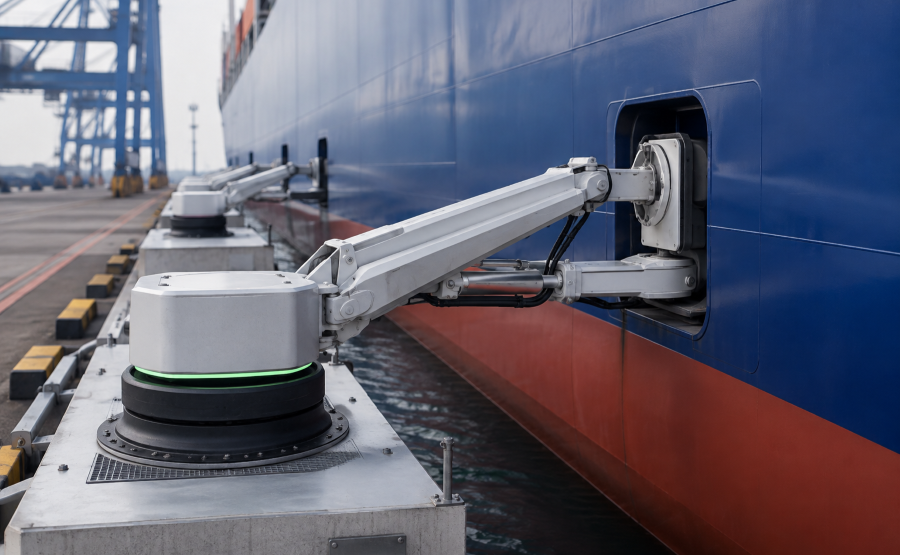
Swedish engineering group Cavotec has won the bid to install an Automated Mooring System (AMS) at Gateway Terminals India Pvt Ltd (GTI), one of the private container terminals at Jawaharlal Nehru Port (JN Port). The project will mark the first deployment of an automated mooring system at an Indian port and is being undertaken as a pilot initiative by the Jawaharlal Nehru Port Authority (JNPA).
The initiative is aimed at improving operational safety and terminal productivity while reducing vessel turnaround time by automating the mooring and unmooring process.
Cavotec will install its MoorMaster automated mooring technology, which uses automated vacuum pads instead of conventional mooring ropes. The system can secure and release vessels within seconds at the push of a button, eliminating the need for personnel to handle heavy mooring lines in potentially hazardous conditions.
GTI is 74% owned by APM Terminals Management BV, the container terminal operating arm of Danish shipping and logistics major A.P. Moller–Maersk, while the remaining 26% is held by state-owned Container Corporation of India (CONCOR).
Boosting Capacity Within Existing Berth Constraints
GTI currently has a container handling capacity of around 2.18 million TEUs and is targeting an increase to 3 million TEUs over the next few years. The terminal aims to handle approximately 2.4 million TEUs in the financial year ending March 2027.
However, with a quay length of only 712 metres, the terminal has limited scope to expand physically. GTI is therefore looking at productivity and operational efficiency improvements to accommodate additional vessel and cargo volumes.
The terminal has already undertaken significant berth improvement works. In 2023, GTI installed advanced quay cranes as part of a berth refurbishment and modification programme, including an extension of the south bridge and installation of dolphin moorings, enabling the terminal to accommodate somewhat larger vessels.
The automated mooring system is now being considered as another way to increase effective berth utilisation without physically extending the quay.
A terminal source said the system could help GTI create additional effective berth space and potentially accommodate larger vessels simultaneously.
At present, when a vessel of around 368 metres is berthed, GTI cannot simultaneously accommodate another vessel of around 300 metres, which is a typical size for vessels calling at JN Port. The terminal is examining ways to create an additional 10–12 metres of effective berth space to overcome this constraint.
One Hour Saved Per Vessel
Conventional mooring and unmooring operations can take about 1 hour, significantly increasing vessel turnaround time.
With Cavotec’s MoorMaster system, the mooring operation can reportedly be completed in around 60 seconds, while unmooring can take approximately 30 seconds.
For GTI, which handles more than 500 vessels annually, saving about one hour per vessel could translate into roughly 500 hours, or 21 additional days of operational time, every year.
The additional operational time could enable the terminal to handle more cargo without expanding its physical infrastructure.
GTI currently handles around 3,000–4,000 TEUs a day, making every additional hour of berth availability commercially significant.
More Berth Space Without Conventional Mooring Lines
One of the major benefits of the technology is the elimination of conventional mooring ropes.
Traditional mooring arrangements require a safety gap between vessels to accommodate mooring lines and ensure safe operations. According to the terminal source, the required gap between two vessels could potentially be reduced from around 25 metres to 15 metres when conventional mooring ropes are eliminated.
This could provide GTI with additional effective berth space and improve its ability to accommodate vessels simultaneously.
The automated system is also expected to improve vessel stability during cargo operations. This could be particularly useful at JN Port, where tidal conditions can cause vessels to surge up and down while alongside.
A more stable vessel position would reduce the need for crane operators to continuously compensate for vessel movement, potentially improving quay crane productivity.
Automated Response to Vessel Surging
Another advantage is the system’s ability to automatically respond to vessel surging caused by passing ships and associated water movements.
At present, such movements can require adjustments to conventional mooring lines. The automated system, controlled through computer-based technology, can detect vessel movement and make corresponding adjustments, helping maintain a more stable position alongside the berth.
This could contribute to smoother crane operations and reduce interruptions during cargo handling.
Ability to Move Vessels Along the Berth
The system also offers GTI an additional operational advantage: the ability to reposition a vessel along the berth.
According to the terminal source, the automated system can lock, unlock and slowly move a vessel by approximately 10 metres every 20 minutes.
This could provide GTI with greater flexibility in berth planning. For example, once cargo operations are completed in the first few bays of a vessel, the ship could potentially be shifted to create additional space for another vessel.
Under conventional arrangements, such movements may require coordination with the port authority and the use of a pilot vessel. Automated mooring could reduce this dependency for small berth-positioning adjustments.
GTI Seeks Expansion to Second Berth
JNPA is currently funding the pilot deployment on one GTI berth. However, GTI is keen to install the system on its second berth as well so that the terminal can derive the full operational benefits.
The terminal operator already has experience with Cavotec’s automated mooring technology at several overseas facilities, including terminals in Salalah and Tangier Med, as well as other European locations.
The system is expected to be operational at GTI by the end of 2027.
The pilot at JN Port could provide an important test case for the wider adoption of automated mooring technology across Indian ports. If successful, the technology could help terminals increase effective berth capacity, improve safety and vessel productivity, and reduce turnaround times without requiring major physical expansion of existing quays.