
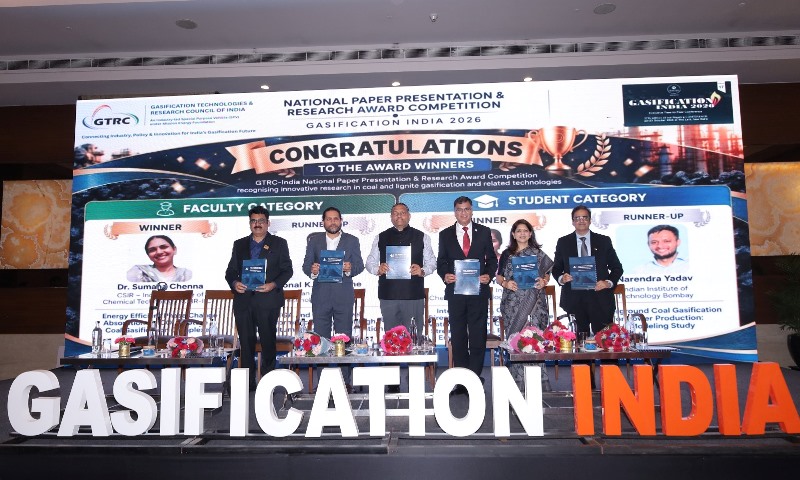
Alvarez & Marsal (A&M) has called for faster project approvals, long-term offtake agreements and stronger execution mechanisms to help India achieve its target of gasifying 100 million tonnes of coal annually by 2030.
The recommendations are outlined in A&M’s report, Coal Gasification for ‘Atmanirbhar Bharat’: Shaping the Next Industrial Revolution, launched at the Gasification Summit in Delhi in the presence of Union Minister of Coal and Mines G. Kishan Reddy.
The Ministry of Coal has projected investments of ₹2.5–3 lakh crore across around 25 projects to achieve the target. However, the report emphasises that access to coal alone will not be sufficient. The pace of clearances, availability of assured buyers and effective project execution will be critical to translating the ambition into commercially viable industrial projects.
India holds the world’s fifth-largest coal reserves but continues to depend heavily on imports of methanol, natural gas and fertilisers. Coal gasification offers an opportunity to convert domestic coal into these products, reduce import dependence and strengthen the country’s industrial self-reliance. However, commercial viability, technology adaptation and implementation challenges remain significant barriers.
To address these issues, A&M recommends establishing a single statutory clearance window with fixed timelines and deemed approval provisions. It also advocates long-term offtake agreements to improve project bankability and stronger coordination among utilities, contractors and technology providers.
Unveiling the report, Balasaheb Darade, Managing Director, New Era Cleantech, said coal gasification was an important component of India’s efforts to reduce import dependence and build a self-reliant industrial base. He highlighted the value of industry perspectives that focus on translating policy intent into implementation and called for greater alignment among stakeholders to achieve the 2030 target.
Kunwar Vijayant Singh, Managing Director and Co-Lead, Energy and Resources, Alvarez & Marsal India, said India had both the coal reserves and the domestic demand needed to support the initiative. Achieving the target, he noted, would depend on the speed of approvals, assured buyers, reliable utilities, accountable contractors and technologies suited to Indian coal.
He added that coordinated action across these areas could help transform coal gasification from a collection of individual projects into an integrated industrial value chain.
Key Findings and Recommendations
Reducing import dependence: The report notes that imports accounted for approximately 94% of India’s methanol consumption and around 50% of its natural gas consumption in FY25. In FY26, natural gas imports were valued at approximately ₹1.18 lakh crore, while urea imports amounted to around ₹46,000 crore.
Streamlining project approvals: Gasification projects require clearances from multiple authorities. Drawing on initiatives such as PM Gati Shakti, the report proposes a single statutory window with defined timelines and deemed approval provisions to accelerate project implementation.
Securing long-term offtake agreements: Assured demand is essential to making capital-intensive projects financially viable. The report cites India’s ethanol programme and the Great Plains plant in the United States as examples of long-term offtake models. It also highlights Coal India’s agreement to procure ammonium nitrate from Bharat Coal Gasification and Chemicals Limited’s Lakhanpur project for use in mine blasting.
Applying lessons from Talcher: The Talcher coal-to-urea project in Odisha was 72.56% complete as of June 2026. The report identifies reliable utilities, technology suited to Indian coal characteristics and stronger contractor accountability as important lessons for future projects.
Strengthening technology and infrastructure: A&M calls for greater research and development funding, pilot projects to adapt gasification technologies to India’s high-ash coal, and integrated industrial hubs with shared infrastructure. It also stresses the need to incorporate environmental safeguards into project design.
The report concludes that appropriate policy support, commercially viable offtake arrangements and disciplined project execution will be essential to unlocking the potential of coal gasification. With these enablers in place, the sector could help reduce import dependence, strengthen domestic manufacturing and advance India’s Atmanirbhar Bharat ambitions.