
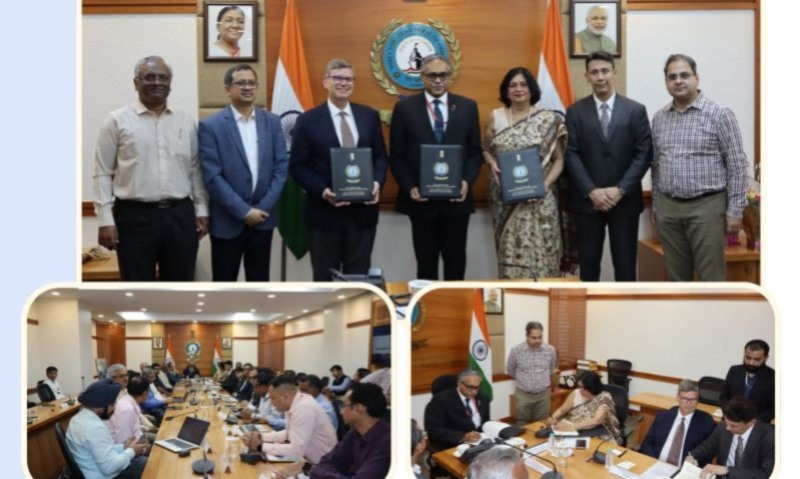
In a significant step towards advancing India’s maritime sustainability goals, the Directorate General of Maritime Administration (DGMA) has signed a tripartite Memorandum of Understanding (MoU) with the National Centre of Excellence in Green Ports & Shipping (NCoEGPS), TERI, and the Smart Freight Centre (SFC) to strengthen collaboration on maritime decarbonisation.
The MoU was signed by Shri Shyam Jagannathan, IAS, Director General of Maritime Administration, Dr. Vibha Dhawan, Director General, TERI and Chairperson, NCoEGPS, and Capt. Prashant S. Widge, Executive Director – India & Maritime, Smart Freight Centre.
The signing ceremony was attended by Shri Killi Mohana Rao, Chief Surveyor (I/c), DGMA; Capt. S. I. Abul Kalam Azad, Nautical Adviser (I/c), DGMA; Dr. Christoph Wolff, Chief Executive Officer, Smart Freight Centre; Mr. Souvik Bhattacharjya, Director, TERI; along with senior officials and representatives from DGMA, NCoEGPS, TERI and the Smart Freight Centre.
The strategic partnership is aimed at supporting the implementation of India’s National Maritime Decarbonisation Policy Framework (NMDP) through technical cooperation, pilot projects, capacity building, international collaboration and knowledge exchange.
Under the agreement, the partners will work together to promote green shipping practices, develop green ports and sustainable marine fuels, encourage responsible ship recycling, establish harmonised emissions accounting frameworks, and create the India Maritime Decarbonisation Knowledge Hub.
The collaboration brings together national institutions and international expertise to accelerate the transition towards a low-carbon maritime sector. It also reinforces India’s commitment to building a sustainable, resilient and future-ready maritime ecosystem while strengthening its position as a global leader in maritime decarbonisation.