
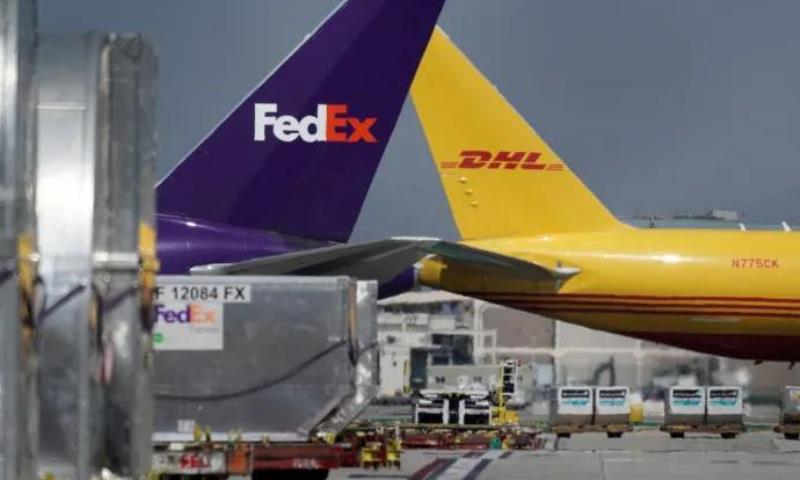
Global express logistics operators FedEx and DHL Express are expanding their focus on air cargo, capitalising on growing demand for heavier shipments, capacity constraints in conventional airfreight and the increasing need for reliable, time-sensitive transportation.
FedEx reported a 15% year-on-year increase in international airfreight daily freight pounds during its third quarter, reflecting the company’s stronger emphasis on air cargo volumes. FedEx Chief Executive Raj Subramaniam also highlighted a 15-fold increase in aircraft engine movements, underlining the growing importance of specialised, high-value cargo.
The company has secured new airfreight business from an artificial intelligence (AI) data centre customer, following a relationship spanning more than 40 years that was previously focused largely on parcel shipments.
In response to rising demand, FedEx has introduced a new transportation product for aircraft engines and aerospace components. The initiative comes amid increasing aircraft maintenance requirements, longer delivery lead times, spare-parts shortages and pressure on airlines to maximise fleet availability.
FedEx has also been adapting its network to accommodate heavier and higher-value shipments. Last year, it transferred a freighter from its express network to its air cargo operations, targeting commodities such as pharmaceuticals and automotive products.
DHL Express is pursuing a similar strategy. At the beginning of the year, it introduced its Heavy Weight Express (HWX) service, designed to handle shipments weighing up to 1,000 kg per piece and 3,000 kg per consignment.
DHL’s third-quarter results also reflected stronger demand for airfreight services within its Express division. The company reported an increase in airfreight shipments, contributing approximately EUR 100 million to earnings during the quarter. Daily shipment weight in its Time Definite International (TDI) business increased 9.7% year on year, partly driven by its focus on heavier cargo.
According to DHL, capacity constraints in the conventional airfreight market have encouraged customers to shift towards express services, supporting the additional earnings.
DHL Express Europe Chief Executive Mike Parra has attributed the trend to geopolitical uncertainty and supply chain volatility. He noted that customers increasingly value the speed, reliability, predictable transit times and straightforward pricing offered by express services.
The shift could represent a longer-term change in customer behaviour rather than a temporary response to market disruptions, as businesses become accustomed to higher service reliability and guaranteed capacity. DHL has also clarified that its strategy is not intended to divert business from its forwarding division, pointing instead to specialised urgent requirements, such as transporting a 300 kg replacement component for a grounded oil rig.
Changes in global e-commerce supply chains are providing another growth opportunity. The removal of de minimis exemptions in certain markets has encouraged online sales platforms to adopt more traditional supply chain arrangements, creating opportunities for express operators to handle shipments through freight services rather than conventional parcel networks.
Slower growth in some traditional parcel markets has also enabled express companies to deploy existing freighter capacity more effectively for heavier consignments.
The growing convergence of express and air cargo services highlights a shift in the global air logistics market. With integrated networks, controlled handling, predictable transit schedules and guaranteed uplift becoming increasingly important, express operators are strengthening their position in the high-value and time-critical air cargo segment.