
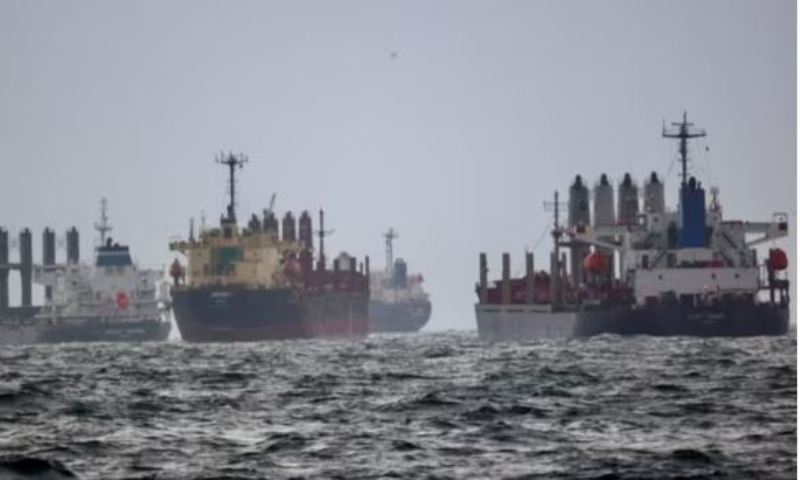
Five new ships are on their way to Ukrainian sea ports using a new corridor opened to resume predominantly agricultural exports, an alternative arrangement to the Black Sea grain deal blocked by Russia, the MarineTraffic database showed on Sunday.
The MarineTraffic database showed earlier on Sunday that three cargo vessels left Ukrainian Black Sea ports after loading, the latest to sail since Kyiv set up a temporary “humanitarian corridor” after Russia quit a deal allowing safe passage for Ukraine exports.
The database identified the five vessels heading towards the ports as Olga, Ida, Forza Doria, New Legacy and Danny Boy.
Deputy Prime Minister Oleksandr Kubrakov said last month that three cargo ships were heading towards Ukrainian Black Sea ports for further food and steel exports.
Bulk carriers Azara, Ying Hao 01 and Eneida were due to load 127,000 metric tons of agricultural products and iron ore for China, Egypt and Spain.
After it invaded Ukraine last year, Moscow closed off the Black Sea ports of one of the world’s biggest suppliers of grain, in what Kyiv and its Western backers called an attempt to use global food supplies as blackmail.
Moscow said the ports could be used to bring in weapons.
The ports were reopened in July 2022 under a deal brokered by the United Nations and Turkey that allowed Russia to inspect ships for arms.
Moscow quit the deal a year later and reimposed the blockade, saying its demands for better terms for its own food and fertiliser exports were being ignored.