
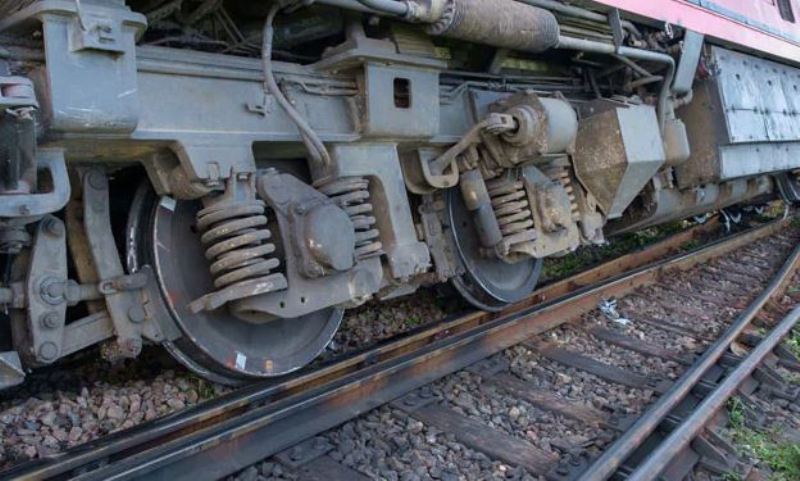
A freight train derailment that disrupted access to a port for two weeks was caused by a wagon type “susceptible to derailment”.
Five wagons of a train derailed at about 05:45 GMT on 24 December 2021 as it was entering the rail terminal at London Gateway port in Essex.
The wagon was susceptible “when large longitudinal compressive forces are suddenly applied”, a report found.
The Rail Accident Investigation Branch (RAIB) made several recommendations.
No-one was injured in the derailment but damage to infrastructure meant rail freight access to the port was disrupted for 14 days.
It started when wheels on one wagon in the middle section of the train suddenly lifted off the track, just before the port boundary, with the other wagons becoming derailed as they passed over points within the rail terminal.
‘Design changes’
The RAIB said derailments in 2015 involving an earlier version of the triple wagon had shown the design was “susceptible to derailment when large longitudinal compressive forces are suddenly applied”.
Simulations carried out as part of the investigation showed a new version “remained similarly susceptible to derailment”.
The lack of load in the centre of the triple wagon and possible “in-service degradation” of the bogie also “increased the derailment risk”, the RAIB said.
It recommended that VTG Rail, the owner and developer of the triple-wagon, identify and implement any necessary design changes and operating restrictions.
GB Railfreight, the operator of the train, should develop instructions and best practice guidance for its operations staff and for the Rail Safety and Standards Board (RSSB), to raise the rail industry’s understanding of the derailment risks associated with longitudinal compressive forces and the management strategies that need to be introduced.
A spokesperson for the RSSB said: “Improving the operational and safety performance of freight trains is a priority for RSSB and the rail industry, and we will be working together to review the implementation of RAIB’s recommendations.”