
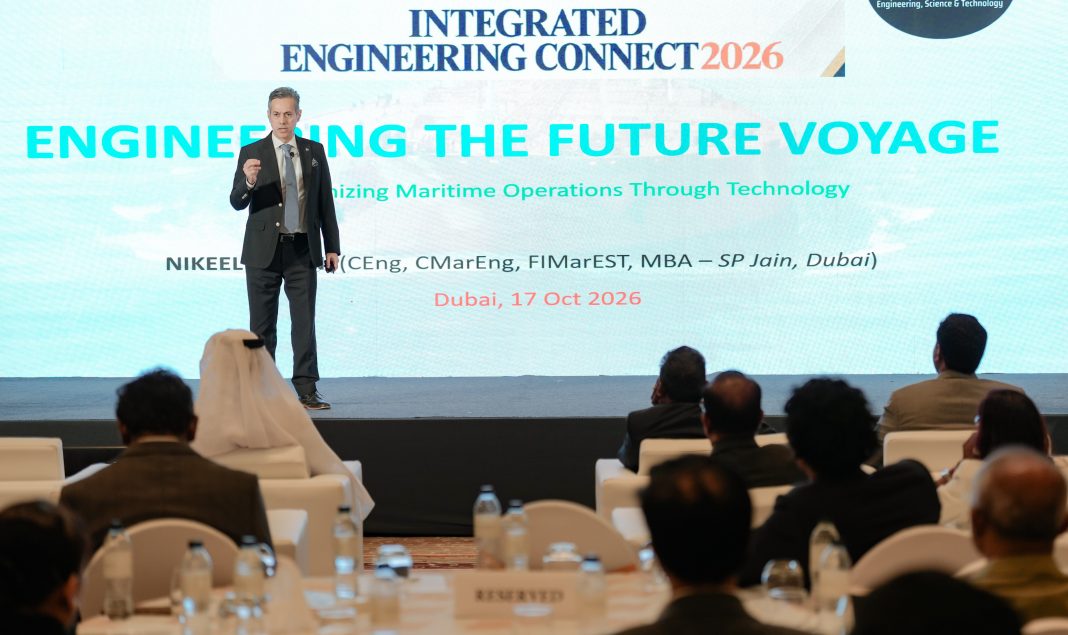
Nikeel Idnani, Honorary Secretary of the UAE branch of the Institute of Marine Engineering, Science & Technology (IMarEST), highlighted practical engineering solutions for maritime decarbonisation at Integrated Engineering Connect 2026, organised by the International Tamil Engineers Forum in the UAE on October 17 at Millennium Plaza Downtown Hotel, Dubai.
The full-day event brought together more than 600 engineering professionals, senior government officials and industry executives from the energy, construction and technology sectors.
In his presentation, titled “Engineering the Future Voyage,” Idnani addressed the shipping industry’s challenge of reducing greenhouse gas emissions while continuing to facilitate more than 80% of global trade. He discussed the sector’s contribution to global emissions and the growing importance of regulatory frameworks, including the Energy Efficiency Existing Ship Index (EEXI) and Carbon Intensity Indicator (CII).
Highlighting the high investment requirements and slow pace of the transition to alternative marine fuels, Idnani emphasised the potential of immediate, cost-effective engineering interventions. He particularly focused on reducing hydrodynamic friction through effective hull maintenance, explaining that maintaining a smooth hull surface can improve power efficiency by up to 18%, reduce speed loss and lower fuel consumption.
His presentation underlined the importance of combining long-term investments in alternative fuels with readily implementable measures that can deliver near-term environmental and commercial benefits. The approach positions marine engineers to contribute directly to the shipping industry’s decarbonisation efforts while improving operational efficiency.
Idnani’s participation also highlighted IMarEST’s role in promoting marine engineering expertise and advancing practical solutions to the challenges facing the global maritime industry.
Established in London in 1889, IMarEST is an international professional body and learned society for marine engineers, scientists and technologists. The institute has consultative status at the International Maritime Organization (IMO) and works with governments and industry stakeholders worldwide to promote knowledge-sharing and professional development across the marine sector.