
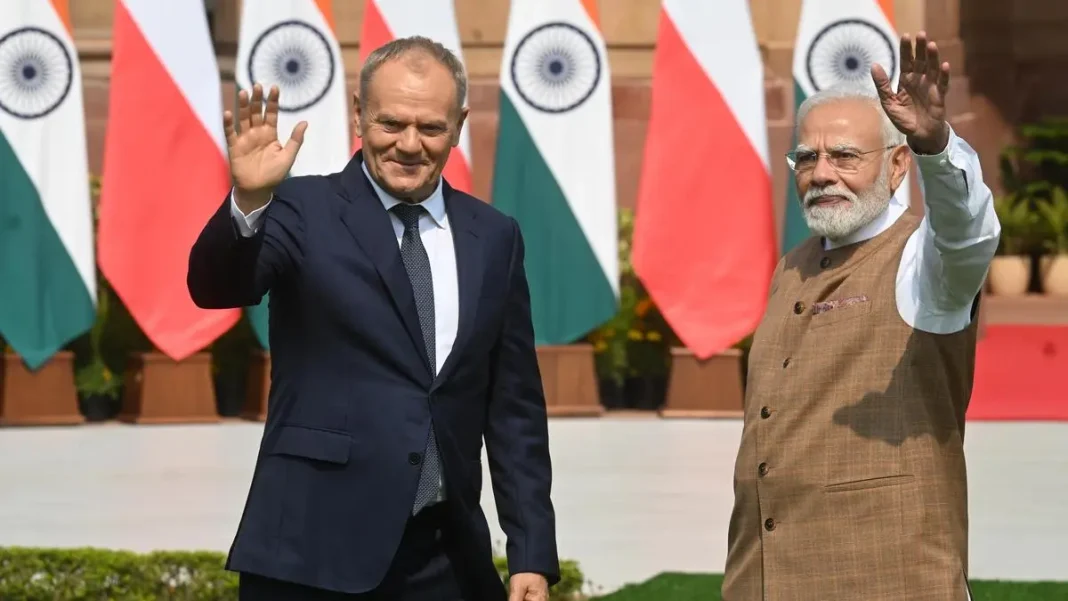
Prime Minister Narendra Modi and Polish Prime Minister Donald Tusk on Thursday called for the early signing, ratification and implementation of the India–European Union Free Trade Agreement (FTA), while agreeing to work towards doubling bilateral trade between India and Poland by 2030.
The two leaders discussed expanding economic cooperation and strengthening strategic ties across key sectors, including manufacturing, defence, critical and emerging technologies, artificial intelligence (AI), semiconductors and green energy. The discussions also focused on improving connectivity and facilitating trade through enhanced cooperation in aviation, ports and maritime security.
According to the India–Poland joint statement, the two prime ministers emphasised the importance of accelerating the India–EU FTA process to unlock new opportunities for trade and investment, strengthen supply chains and expand market access for businesses in both countries.
“On the FTA, the PMs called for its early signing and ratification as well as timely implementation, with a view to unlocking new opportunities for trade and investment, diversifying and strengthening critical value chains, and opening new markets,” the joint statement said.
The proposed agreement is expected to provide a framework for strengthening commercial engagement between India and the European Union by improving market access and creating opportunities for businesses across manufacturing, services and other economic sectors. Greater trade cooperation could also support companies seeking to diversify sourcing and production networks amid changes in global supply chains.
India and Poland also agreed to pursue the goal of doubling bilateral trade by 2030, underlining their shared interest in expanding economic engagement. Cooperation in manufacturing, defence and advanced technologies is expected to remain an important component of the broader partnership.
Connectivity and maritime cooperation formed another key area of discussion. The leaders explored strategic connectivity initiatives, including the possibility of direct air links, greater cooperation between ports and enhanced maritime security. These measures could help improve business travel, cargo movement and commercial connections between the two countries.
The discussions also covered alignment with the India–Middle East–Europe Economic Corridor (IMEC), a proposed connectivity initiative intended to strengthen trade and transport links between India, the Middle East and Europe. Cooperation in this area could create additional opportunities to improve multimodal connectivity and logistics efficiency, subject to the development and implementation of the corridor.
For the maritime and logistics sectors, closer port cooperation and improved connectivity could support trade facilitation, cargo movement and stronger links between Indian gateways and European markets. Enhanced maritime security cooperation would also be relevant to protecting shipping routes and maintaining the reliability of international trade networks.
The discussions reflect the broader effort by India and Poland to expand their economic relationship while strengthening cooperation in strategic industries, technology and transport infrastructure. With both countries targeting a doubling of bilateral trade by 2030, the early implementation of the India–EU FTA and progress on connectivity initiatives could become important factors in achieving their shared trade ambitions.