
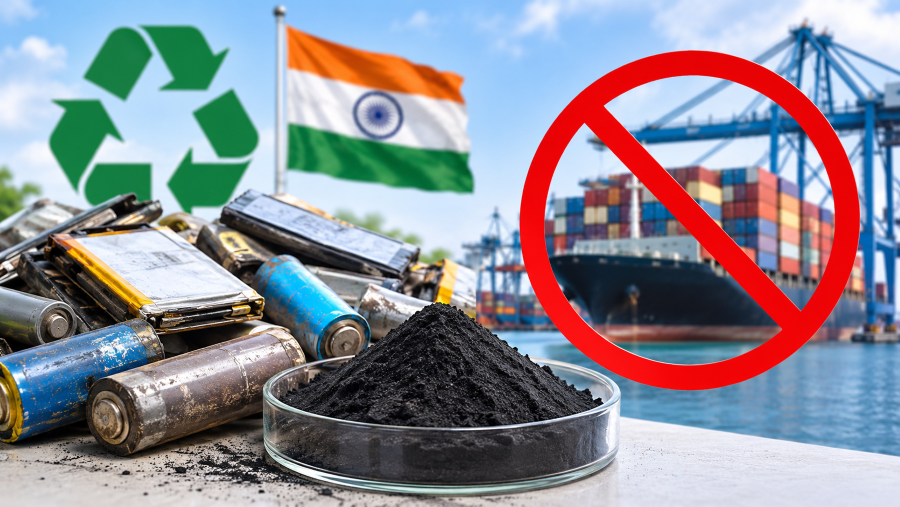
The government has prohibited the export of lithium-ion battery black mass and a specified category of battery waste and scrap with immediate effect, in a move aimed at strengthening domestic battery recycling and improving access to critical minerals.
The Directorate General of Foreign Trade (DGFT), under the Ministry of Commerce and Industry, has amended the export policy for the covered materials under ITC (HS) code 85491400, changing their classification from ‘Free’ to ‘Prohibited’. The restriction, announced through a notification dated November 10, will remain in force until further orders.
The prohibition covers unsorted waste and scrap of primary cells, primary batteries and electric accumulators, including spent batteries that do not contain lead, cadmium or mercury. Lithium-ion battery black mass has been specifically included in the restricted category.
The government has clarified the scope of the measure through the specified tariff classification. The notification does not impose a blanket ban on exports of all types of batteries, battery waste or battery-related products.
Black mass is a powder-like intermediate material produced by dismantling, crushing and processing used lithium-ion batteries. Depending on the battery chemistry, it contains valuable materials such as lithium, nickel, cobalt, manganese and graphite, which can be recovered and reused in battery manufacturing.
These recovered minerals are critical inputs for electric vehicles, consumer electronics and energy storage systems, making black mass an important resource for the emerging battery recycling industry.
The export restriction comes amid India’s efforts to build domestic capabilities in critical mineral recovery and reduce dependence on imported resources. The government has identified the need to expand domestic processing capacity to extract valuable minerals from spent batteries and other recyclable materials.
Its ₹1,500-crore incentive scheme for critical mineral recycling is aimed at encouraging investment in the recovery of strategic minerals from spent batteries, electronic waste and other eligible scrap.
By retaining more black mass within the country, the new policy could improve raw material availability for Indian recyclers and support the development of a domestic battery recycling ecosystem. However, the actual benefits will depend on the industry’s ability to scale up processing capacity and recover minerals of the quality required for industrial applications.
The DGFT notification also states that transitional arrangements under Paragraph 1.05 of the Foreign Trade Policy 2023 will apply, requiring existing export commitments to be assessed in accordance with the relevant provisions.