
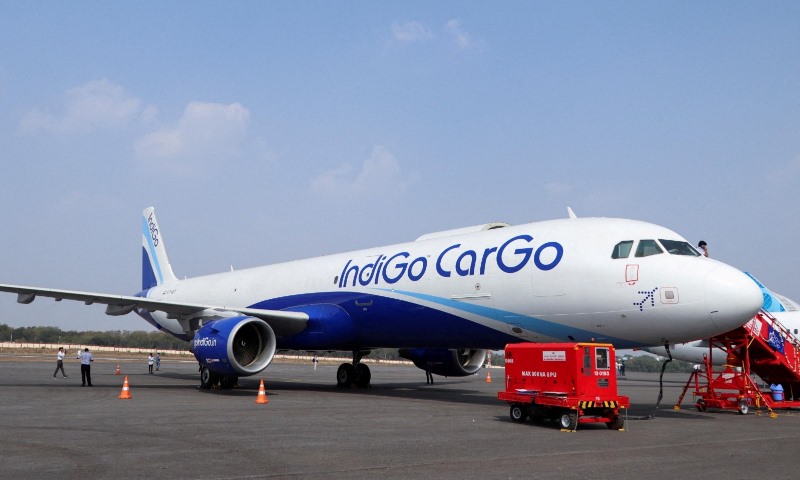
India’s civil aviation industry handled 246.1 million domestic and international passengers in FY26, registering a modest 2.7% year-on-year growth, even as air cargo traffic recorded a strong expansion of over 20%, according to the Directorate General of Civil Aviation’s (DGCA) Handbook on Civil Aviation Statistics 2025-26.
Domestic passenger traffic grew 1.1% to 167.4 million, while international traffic increased 6.1% to 78.7 million. The slowdown in domestic passenger growth compared with 7.7% in FY25 indicates a moderation in market expansion.
In contrast, domestic cargo carried by scheduled airlines surged 24% to 978,000 tonnes, while international cargo rose 20.6% to 2.13 million tonnes. Total air cargo traffic reached approximately 3.11 million tonnes during the year.
A significant development was the increase in Indian airlines’ share of international cargo traffic to 25%, up from 16.7% in FY25, although foreign carriers continued to handle the remaining 75%.
Passenger aircraft played an increasingly important role in domestic freight movement, with belly cargo accounting for 85.1% of domestic cargo, compared with 80.5% a year earlier. Dedicated freighters handled the remaining 14.9%, with Blue Dart and Quikjet Cargo identified as the only dedicated cargo operators in the domestic sector.
In international freight, Europe accounted for the largest share of inbound cargo at 31.4%, followed by Africa and the Middle East at 23.5% and Asia-Pacific at 22.7%. For outbound cargo, Africa and the Middle East led with a 40.1% share, followed by Europe at 37.2%.
IndiGo retained its dominance in the domestic passenger market with a 63% share, followed by Air India at 13.6% and Air India Express at 6.3%. The industry’s domestic passenger load factor stood at 85.2%, with Akasa Air recording the highest at 92.1%.
Indian airlines accounted for 44.4% of international passenger traffic, while foreign carriers handled 55.6%. The Middle East and Africa remained the largest international aviation markets, together accounting for more than half of inbound and outbound passenger traffic.
The DGCA also reported that scheduled domestic aircraft departures remained broadly unchanged at 11.39 lakh, while international departures increased 5.2% to 4.5 lakh. Aviation turbine fuel consumption rose 2% to 9.16 million tonnes.
The handbook recorded 866 aircraft in the fleets of scheduled Indian operators as of March 2025. It also highlighted the industry’s cost structure, with fuel and oil accounting for 36% of airline operating expenses, followed by maintenance and overhaul at 16.2%.
IndiGo reported operating revenue of approximately ₹80,543 crore and an operating surplus of ₹9,869 crore in FY25, while Air India and Air India Express continued to report operating losses.
On the safety front, India recorded 11 aviation accidents in calendar year 2025, compared with six in 2024. However, serious incidents declined from nine to six.
The DGCA said the FY26 figures are provisional. The handbook consolidates data on passenger and cargo traffic, airline operations, fleet strength, financial performance, employment and aviation safety.