
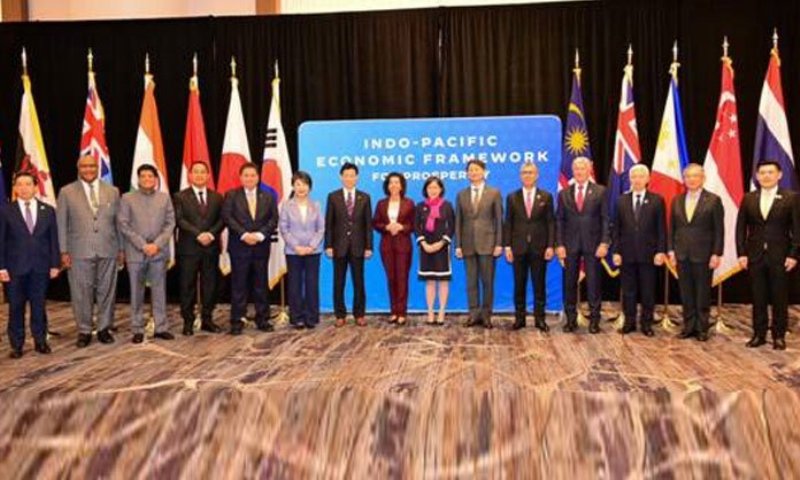
The supply chain resilience agreement of the Indo-Pacific Economic Framework for Prosperity (IPEF) will not curb New Delhi’s policy space to impose export restrictions, a government official said on Tuesday.
Additional Secretary at the commerce ministry, Rajesh Agarwal clarified that the agreement mentioned imposing “unnecessary” export restrictions, but it is caveated and is similar to the World Trade Organization (WTO) provisions and not beyond that. If a country imposes any export curb without giving any justification, that is treated as unnecessary, he clarified.
Use of export restrictions assumes significance as India has extensively used measures to ensure food security and arrest food prices in the run up to the general elections. “Under the supply chain agreement, there is nothing where in our policy space to exercise our rights of change in tariffs or change in export policy…whatever is necessary for the country’s food security or any other requirement of the country also, that policy space remains with us,” Agarwal said. According to him, India will not have to provide any kind of advance information to IPEF members about doing any change in customs duties.
IPEF was launched jointly by the United States and other partner countries of the Indo-Pacific region on May 23 last year largely to counter China’s influence on trade.
The framework is structured around four pillars relating to trade, supply chains, clean economy and fair economy (issues like tax and anti-corruption). India has joined all the pillars except trade.
Australia, Brunei Darussalam, Fiji, India, Indonesia, Japan, the South Korea, Malaysia, New Zealand, the Philippines, Singapore, Thailand, the US and Vietnam are members of the bloc.