
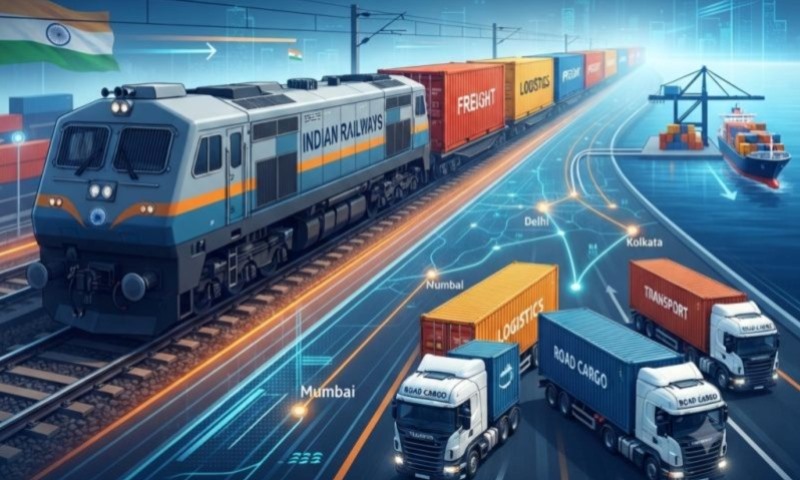
In a major initiative to strengthen the logistics infrastructure of Jammu and Kashmir, the Directorate of Industries and Commerce, Jammu, and the Jammu Division of Northern Railway have agreed to work together to establish an efficient, cost-effective and integrated supply chain network for the region.
A high-level coordination meeting held on Saturday brought together government officials, railway policymakers, industrialists and logistics operators to explore ways to modernise freight transportation and improve multimodal connectivity across the region.
The initiative aims to establish long-term coordination between local manufacturing units, the Directorate of Industries and Commerce and Indian Railways, while achieving time-bound targets under the National Logistics Policy (NLP).
Discussions focused on reviewing existing freight transportation systems, encouraging a shift towards rail-based cargo movement and developing an effective multimodal connectivity network to reduce transit times and overall logistics costs for businesses.
Indian Railways was represented by Uchit Singhal, Senior Divisional Commercial Manager, Jammu Division, while Dr Arun Manhas, Director, Industries and Commerce, Jammu, led the departmental delegation. Both officers interacted with industrial representatives, addressed operational concerns and discussed a roadmap for future infrastructure expansion.
General Managers of the District Industries Centres of Samba, Kathua, Udhampur and Jammu also participated in the meeting.
The industrial sector’s concerns and priorities were highlighted by Tarun Singla, President of the Bari Brahmana Industries Association (BBIA), along with other industry representatives and logistics operators.
Detailed presentations were made on the existing and proposed freight-handling capacities of Indian Railways. The discussions also explored the integration of future cargo terminals, dedicated industrial railway sidings and paperless digital tracking systems with the PM Gati Shakti National Master Plan.
The proposed measures are expected to improve last-mile connectivity to manufacturing hubs across Jammu and Kashmir, facilitate seamless freight movement and reduce logistics bottlenecks.
The collaboration is also expected to enhance the competitiveness of regional industries by providing more reliable, efficient and economical transportation options, strengthening the region’s integration with national supply chains.