
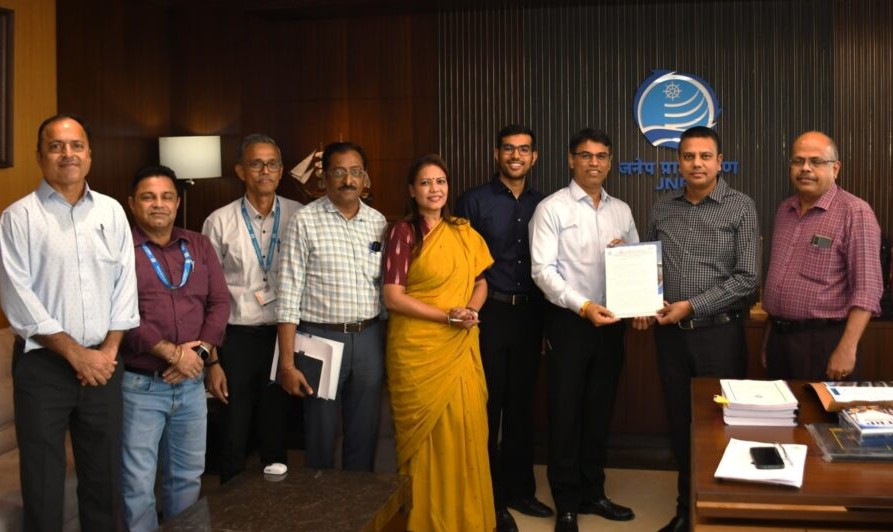
The Jawaharlal Nehru Port Authority (JNPA) has awarded a ₹76.92-crore contract to Navi Mumbai-based Leena Powertech Engineers Private Limited, the lowest (L1) bidder, for implementing the Shore Power Supply (SPS) Project at Gateway Terminals India (GTI). The Letter of Award (LOA) was formally handed over by the Chairman of JNPA.
The project marks a significant milestone in JNPA’s efforts to decarbonise port operations and strengthen its commitment to environmental sustainability, in line with the Government of India’s Green Ports initiative, Maritime India Vision 2030 and the Ministry of Ports, Shipping and Waterways’ Harit Sagar Green Port Guidelines.
Also known as Cold Ironing, shore power technology enables vessels berthed at a port to draw electricity directly from the shore instead of operating their diesel-powered auxiliary generators to meet onboard electricity requirements. These generators typically supply power for lighting, ventilation, refrigeration, pumps and other essential vessel systems during port stays.
The project involves developing dedicated electrical infrastructure, including 33 kV high-voltage distribution systems, medium-voltage Static Frequency Converters (SFCs), 6.6 kV power distribution networks, specialised power cables, shore-side connection equipment, and associated protection, control and monitoring systems. The scope also includes installation, testing and commissioning. The frequency conversion system will ensure compatibility between shore-based electricity and the electrical requirements of visiting vessels in accordance with international standards, including IEC/IEEE 80005.
Once operational, the facility is expected to deliver significant environmental benefits by enabling compatible vessels to switch off their diesel-powered auxiliary generators while berthed. This will help reduce greenhouse gas emissions, including carbon dioxide, as well as nitrogen oxides, sulphur oxides and particulate matter. It will also minimise noise and vibration, contributing to improved air quality and a healthier working environment within the port.
The initiative is also expected to offer operational and economic advantages to shipping lines by reducing onboard fuel consumption and auxiliary engine operating requirements, subject to applicable shore electricity tariffs and vessel-specific consumption.
The GTI Shore Power Project forms part of JNPA’s broader decarbonisation strategy. During FY 2025-26, the port achieved approximately 60% renewable energy utilisation, consuming around 7.44 crore units of renewable electricity against total electricity consumption of approximately 12.40 crore units. This resulted in a reported carbon dioxide offset of around 61,012 metric tonnes.
Commenting on the development, the JNPA Chairman said the award of the ₹76.92-crore project was a significant milestone in the port’s commitment to sustainable and environmentally responsible operations. By enabling vessels to use shore-based electricity instead of diesel-powered generators, JNPA is taking concrete steps towards reducing emissions, improving air quality and promoting cleaner maritime operations, the Chairman noted.
The GTI project represents the first phase of JNPA’s planned shore power programme. The port authority is also pursuing the development of similar facilities at its remaining container terminals through appropriate implementation models, including Public-Private Partnerships (PPP), to extend the benefits across the port.
With this initiative, JNPA is advancing its adoption of globally recognised green technologies and reinforcing its ambition to emerge as one of India’s leading sustainable maritime gateways.