
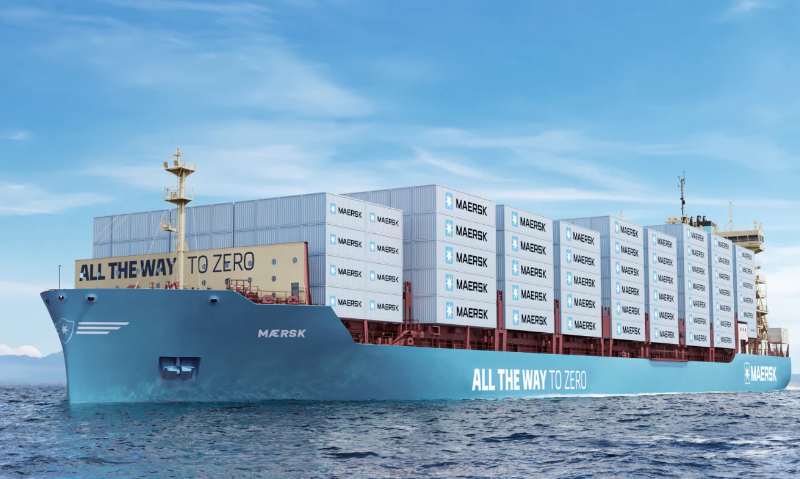
Maersk has launched onboard fuel trials using a methanol–ethanol blend as part of its efforts to explore alternative fuels and accelerate decarbonisation in global shipping. The Danish shipping giant is conducting the trial on the 2,100 teu Laura Maersk, which became the world’s first container vessel to run on green methanol in 2023 and is now being used as a floating test platform.
The latest trial involves an E10 blend comprising 10 per cent ethanol and 90 per cent methanol. The objective is to assess how ethanol performs in dual-fuel marine engines and evaluate its potential role in Maersk’s future fuel mix. Engineers are monitoring ignition quality, combustion behaviour, lubricity, NOx emissions and any operational differences between standard methanol and the E10 blend.
Peter Normark Sørensen, senior fuel transition manager at Maersk, said the decision to blend ethanol is aimed at expanding the availability and sourcing options of alternative fuels for dual-fuel vessels. The E10 supplied to the vessel is expected to last for one to one-and-a-half months, after which Maersk will decide on the next phase of testing.
Sørensen added that the Laura Maersk is ideal for small-scale fuel experiments, which can then be replicated across other dual-fuel ships in the company’s growing fleet.