
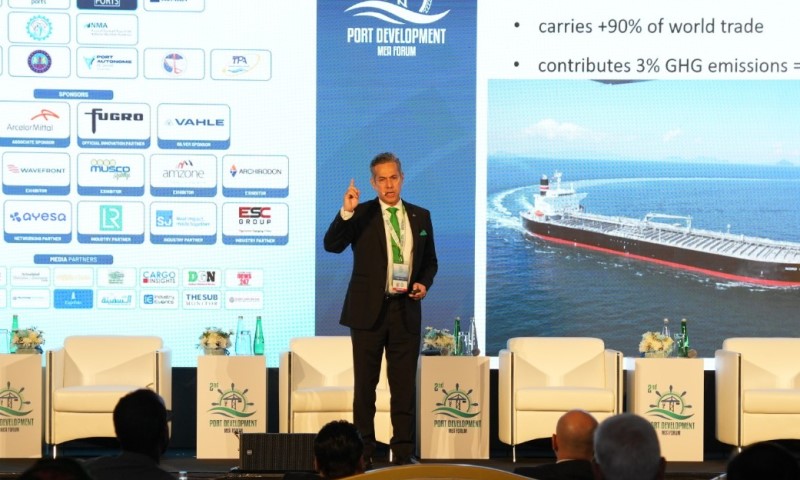
At the Port Development MEA Forum organized by Great Minds Event Management, Nikeel Idnani, Hon. Secretary of the IMarEST UAE Branch, delivered a compelling presentation titled “Coating the Voyage to Profitable Decarbonization.” While the forum primarily focused on port infrastructure and operations, Mr. Idnani broadened the discussion to highlight the critical link between ports and ships—the assets that carry over 90% of global trade and underpin international commerce.
Addressing 206 delegates, he underscored the pivotal role of shipping in the global transition to a low-carbon future. Despite the Marine Environment Protection Committee (MEPC) adjourning its decision on October 17 regarding a Net-Zero Framework aligned with the Paris Agreement’s 1.5°C climate target, Mr. Idnani stressed that the maritime sector is actively accelerating its decarbonization efforts. He detailed technical and operational measures such as the Energy Efficiency Existing Ship Index (EEXI) and the Carbon Intensity Indicator (CII), noting that mid-term targets can be achieved by adopting existing energy-efficient technologies.
A key highlight of his presentation was the discussion on advanced silicone fouling-release coatings, which reduce fuel consumption and emissions. Engaging the audience directly with a ship model, Mr. Idnani vividly demonstrated how hull friction affects vessel efficiency. He cited a case study of a VLCC applying silicone coatings, which projected fuel savings of 16,500 tons worth USD 10.7 million and a reduction of 51,500 tons of CO₂ emissions. The investment, he noted, achieved a return within 11 months and ensured CII compliance for ten years.
Explaining the advantages of silicone coatings, Mr. Idnani said these biocide-free, long-lasting systems create ultra-smooth, non-stick surfaces that minimize friction, prevent marine fouling, and deliver up to 20% power savings. “This is where sustainability meets commercial sense,” he emphasized, highlighting that such coatings help shipowners comply with IMO efficiency targets while improving vessel performance and reducing lifecycle costs.
The session showcased how innovative technologies like silicone coatings can align environmental responsibility with financial performance, offering a practical pathway toward profitable decarbonization in shipping.