
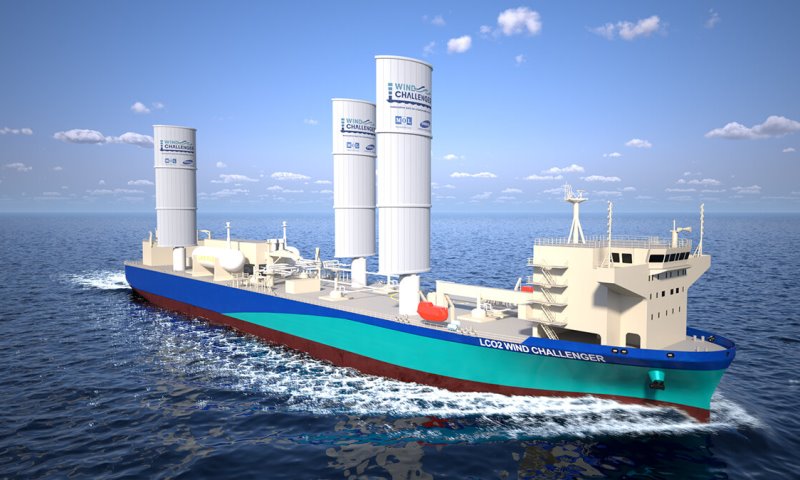
Mitsui O.S.K. Lines (MOL) has secured Approval in Principle (AiP) from Nippon Kaiji Kyokai for an innovative liquefied CO₂ carrier design featuring wind-assisted propulsion.
The vessel, developed in collaboration with Samsung Heavy Industries, will have a cargo capacity of 40,000 cubic meters and be equipped with three “Wind Challenger” rigid sail units. These automated sails can extend, retract, and rotate to harness wind power, reducing reliance on engine propulsion and lowering fuel consumption and greenhouse gas emissions.
To accommodate the sail system, the ship’s bridge and living quarters are positioned toward the bow, improving visibility while allowing installation of the three sails. The design also incorporates safety-focused features such as dedicated passageways, optimized navigation light placement, and carefully positioned lifeboats. A Hazard Identification Study (HAZID) confirmed the vessel’s technical feasibility and safety.
This concept targets cross-border transportation of liquefied CO₂ as part of the broader Carbon Capture and Storage (CCS) value chain. By reducing emissions during transport, it supports global decarbonization efforts.
MOL aims to deploy 25 wind-assisted vessels by 2030 and 80 by 2035 under its “Environmental Vision -BLUE ACTION 2035,” with several ships already delivered or under construction. The new CO₂ carrier marks a significant step toward achieving the company’s goal of net-zero greenhouse gas emissions by 2050 while advancing cleaner maritime transport technologies.