
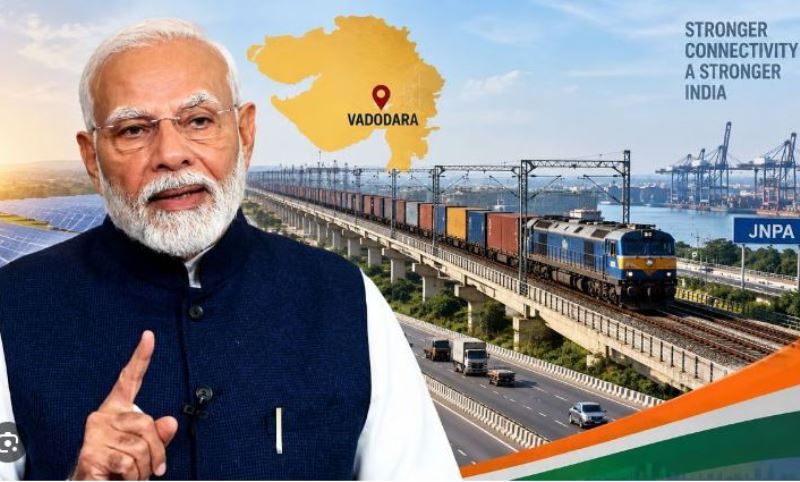
Prime Minister Narendra Modi today marked a major milestone in India’s freight and logistics infrastructure by dedicating the remaining sections of the Western Dedicated Freight Corridor (WDFC) to the nation and flagging off freight train services from four strategic locations — New Sanand (North), New Makarpura, New Umbergaon and New JNPT in Mumbai.
The commissioning of the final stretches formally makes the 1,506-km Western Dedicated Freight Corridor fully operational, completing India’s 2,843-km Dedicated Freight Corridor network, comprising the WDFC and the 1,337-km Eastern Dedicated Freight Corridor.
326 km of new WDFC sections commissioned
The three sections dedicated by the Prime Minister cover a combined 326 route kilometres and have been developed at a cost of more than ₹20,700 crore. They comprise:
New Sanand (North) – New Makarpura
New Umbergaon – New Saphale
New Saphale – New JNPT
The completion of these sections provides direct freight connectivity between major industrial centres in western India and Jawaharlal Nehru Port Authority (JNPA), strengthening the movement of export-import cargo between ports and production centres.
Four strategic freight services flagged off
As part of the programme, Prime Minister Modi flagged off freight train services from:
🚆 New Sanand (North)
🚆 New Makarpura
🚆 New Umbergaon
🚆 New JNPT, Mumbai
These locations are strategically positioned along the Western DFC network, linking industrial clusters, manufacturing centres, logistics hubs and ports. The new operational connectivity is expected to support faster and more reliable cargo evacuation and strengthen the integration of India’s multimodal logistics network.
Faster EXIM cargo movement
One of the most significant benefits of the completed WDFC is its direct rail connectivity to JNPA. This is expected to accelerate the movement of export and import containers between the port and industrial centres across northern and western India.
The dedicated freight infrastructure separates freight operations from passenger railway traffic, creating additional capacity on the conventional railway network while allowing goods trains to operate with greater efficiency and reliability. The government says the DFC network is already carrying an average of more than 443 freight trains a day.
Prime Minister Modi highlighted the operational impact of the DFC network, noting that dedicated freight infrastructure enables significantly faster cargo movement. He also cited the example of a double-stack container train between JNPT and Vadodara, which can carry cargo equivalent to more than 250 trucks in a single movement.
Boost to India’s logistics competitiveness
The completion of the WDFC is expected to have a broad impact on India’s logistics ecosystem by:
Reducing freight transit times
Lowering overall logistics costs
Improving supply-chain efficiency
Increasing freight-carrying capacity
Facilitating double-stack container operations
Strengthening port-rail connectivity
Reducing congestion on Mumbai’s conventional railway network
Improving access to major industrial and manufacturing clusters
The corridor will also provide additional capacity for passenger services on the conventional railway network by shifting a substantial portion of freight traffic onto the dedicated route.
A major milestone for India’s freight infrastructure
The WDFC, stretching from JNPT in Maharashtra to Dadri in Uttar Pradesh, is a critical component of India’s long-term strategy to build efficient freight corridors and strengthen multimodal connectivity. Together with the Eastern DFC, the network is emerging as a backbone for the movement of industrial, containerised, agricultural and bulk cargo across the country.
With the full commissioning of the DFC network, India now has a dedicated rail freight system designed to handle larger volumes of cargo with greater speed, reliability and efficiency — supporting the country’s ambitions to reduce logistics costs and build a more competitive, integrated supply chain.
The commissioning of the Western Dedicated Freight Corridor represents a significant step forward in India’s transition towards faster, more efficient and port-connected freight logistics.