
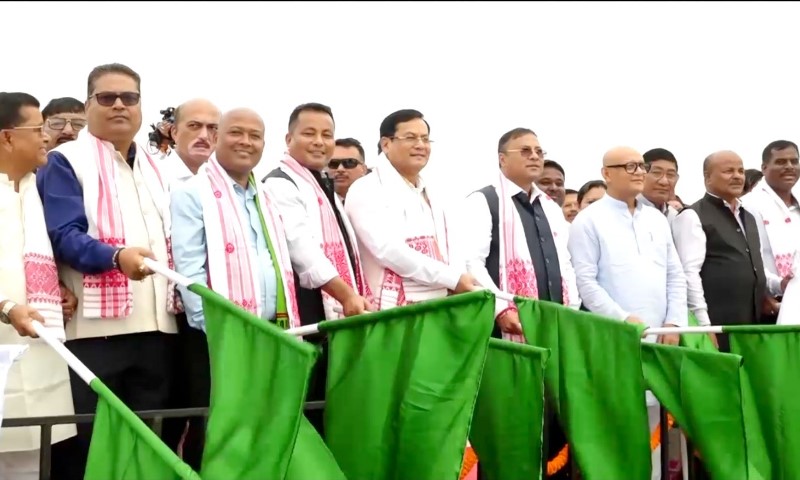
In a landmark revival of Assam’s historic inland waterway trade, a barge carrying 540 tonnes of methanol produced by Assam Petro-Chemicals Ltd (APCL) has departed from the Bogibeel Terminal in Dibrugarh for Dhaka, Bangladesh, marking the first international cargo movement from upper Assam since Independence.
Union Minister for Ports, Shipping and Waterways Sarbananda Sonowal flagged off the vessel DLB Patkai, pushed by tug Kushal Konwar, while Assam Chief Minister Dr Himanta Biswa Sarma joined the event virtually.
The cargo is bound for Pangaon Port in Dhaka. The vessel will travel around 768 km along National Waterway-2 (NW-2) on the Brahmaputra before entering the Indo-Bangladesh Protocol Route, covering approximately 1,300 km from Bogibeel to Narayanganj, Dhaka.
The voyage is being seen as a major test of the Brahmaputra’s potential as a commercially viable freight corridor connecting the Northeast with international markets. Regular methanol shipments to Bangladesh are planned, with the movement facilitated by recently established customs and immigration facilities at Bogibeel and Dhubri.
“This is the first voyage, not the last,” Sonowal said, describing the movement as the revival of Dibrugarh’s historic identity as a river port. He recalled the town’s former steamer services and said, “The steamer whistle that fell silent in 1956 is heard again.”
Chief Minister Sarma called the occasion a proud moment for Assam, noting that a product manufactured in Namrup was now reaching an international market through the State’s own river network.
Dibrugarh was once a major river port, with steamers reaching the town from Calcutta by the mid-19th century. The Dibru-Sadiya Railway began operations from the Dibrugarh steamer ghat in 1882, while regular steamer services carried tea, timber and passengers along the Brahmaputra. River trade declined following Partition, changes in river conditions and the shift of tea cargo to rail, with Dibrugarh Ghat eventually closing in 1956.
The revival of the waterway has gathered momentum in recent years. National Waterway-2, an 891-km stretch of the Brahmaputra from Sadiya to Dhubri, was declared in 1988. Regular cargo movement began in 2017, while Tata Steel barges reached Pandu through Bangladesh in 2022. The MV Ganga Vilas river cruise also travelled from Varanasi to Dibrugarh through Bangladesh in 2023.
The Bogibeel passenger and cargo terminal, for which the foundation stone was laid in 2023, became operational in February 2024. The Centre’s Jalvahak cargo incentive programme, launched in December 2024, has further supported inland waterway cargo movement.
According to the Ministry of Ports, Shipping and Waterways, cargo handled on India’s national waterways increased from 18 million tonnes in 2013-14 to 218 million tonnes in 2025-26. More than ₹6,800 crore is being invested in waterways infrastructure across the Northeast, including NW-2, a ship repair facility at Pandu and last-mile connectivity to Pandu Port.
Sonowal said greater use of waterways could reduce dependence on road transport, adding that every tonne shifted to the river could mean lower fuel consumption and fewer trucks on highways. India is also working with Bangladesh, Nepal, Bhutan and Myanmar to strengthen regional waterway connectivity.
The historic shipment involved the Inland Waterways Authority of India (IWAI), Assam Petro-Chemicals Ltd, Cochin Bunkers Pvt. Ltd. and partners in Bangladesh.
The event was attended by Assam ministers Charan Boro, Bimal Borah and Sushanta Borgohain, Rajya Sabha member Terash Gowalla, Dibrugarh MLA Prasanta Phukan, Khowang MLA Chakradhar Gogoi, IWAI Chief Engineer A.K. Bansal, APCL Chairman Bikul Ch. Deka, and officials from APCL, IWAI and the Assam Government.
The departure of the methanol consignment marks a significant step in reconnecting upper Assam’s industrial output with international markets through the Brahmaputra, potentially positioning NW-2 as a key trade corridor for the Northeast.