
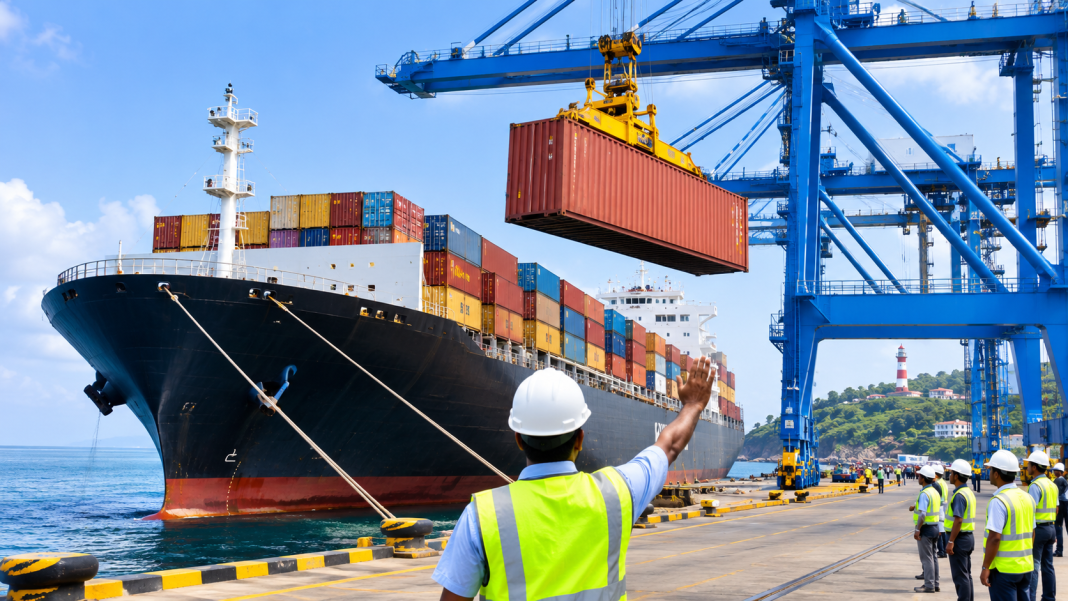
India’s overall exports, comprising merchandise and services, surged 29.9 per cent year-on-year to $89.99 billion in October 2026, compared with $69.27 billion in the corresponding month last year, driven by strong growth in merchandise shipments, according to data released by the Ministry of Commerce and Industry.
Overall imports also increased to $110.07 billion from $94.42 billion a year earlier. However, the combined merchandise and services trade deficit narrowed to $20.09 billion from $25.15 billion in October 2025, as export growth outpaced the increase in imports.
Merchandise exports recorded a sharp 45.06 per cent growth, reaching $49.47 billion in October against $34.11 billion a year earlier. Trade Secretary Rajesh Agrawal said India had achieved its highest-ever monthly merchandise export figure during the month.
Despite the record export performance, the merchandise trade deficit widened significantly to $39.88 billion, its highest level in a year. The deficit was higher than the $30.21 billion recorded in September and the $32.25 billion projected by economists in a Reuters poll.
Merchandise imports rose 16.5 per cent to $89.35 billion in October from $76.69 billion in the year-ago month. On a month-on-month basis, merchandise exports increased from $44.40 billion in September, while imports rose from $74.61 billion.
Services Exports Support Overall Trade Balance
India’s services exports were estimated at $40.51 billion in October, compared with $35.17 billion in October 2025. Services imports also increased to an estimated $20.72 billion from $17.73 billion.
The resulting services trade surplus helped offset the widening merchandise trade deficit, contributing to the improvement in India’s overall trade balance. The ministry clarified that October services figures are estimates, as the latest actual data released by the Reserve Bank of India relates to September.
Oil Imports and Trade Agreements in Focus
India’s trade balance continues to face pressure from its dependence on imported energy. The country, the world’s third-largest oil consumer, imports nearly 85 per cent of its crude oil requirements. Disruptions in global energy markets following the Middle East conflict have increased import cost pressures, although the decline in Brent crude prices to around $92 per barrel has provided some relief.
Meanwhile, India’s export growth has been supported by efforts to diversify overseas markets and strengthen international trade partnerships. Trade agreements with the United Kingdom and New Zealand have been implemented this year, while the proposed trade agreement with the European Union is expected to come into effect early next year.
The latest figures highlight the growing strength of India’s export sector, even as elevated merchandise imports and energy costs continue to pose challenges to the country’s external trade balance.