
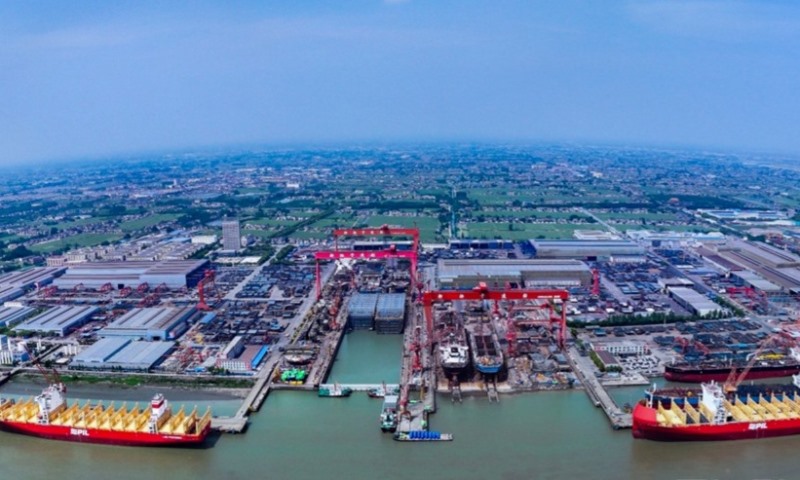
China’s shipbuilders are scheduled to deliver a record 92.7 million deadweight tonnes (dwt) of bulk carriers and tankers in 2028, more than three times the 30.4 million dwt delivered last year, raising concerns over whether the global shipbuilding industry has sufficient capacity to fulfil its rapidly expanding orderbook.
According to fresh research from Italian shipbroker Banchero Costa, the projected 2028 deliveries would significantly exceed the previous annual record of 62.6 million dwt, set in 2011.
The research highlights the unprecedented expansion of the global shipbuilding orderbook. Across seven major merchant shipping segments monitored by the shipbroker, the orderbook stood at 5,488 vessels totalling 172.3 million compensated gross tonnes (cgt) at the end of October. This represents a 24% increase year-on-year and is approximately 31% above the previous peak recorded in 2007.
The findings reinforce earlier estimates by Clarksons Research, which put the global newbuilding backlog at a record 226.1 million cgt, with an estimated value of around $700 billion.
New and revived shipyards add to capacity concerns
One of the most significant developments identified by Banchero Costa is the growing number of new and reactivated shipyards entering the commercial shipbuilding market.
A total of 106 shipyards that did not deliver a single vessel across the seven surveyed sectors between 2019 and 2023 now hold orders for 909 ships. These yards delivered just 1 million cgt last year but are expected to deliver 10.1 million cgt in 2028, accounting for approximately one-sixth of anticipated global output across the sectors.
China’s Hengli Shipbuilding has emerged as a prominent example of this rapid expansion. The Dalian-based yard, which resumed commercial ship deliveries in 2024, delivered 66 vessels during the first 10 months of this year. Its contracted delivery schedule rises to 101 vessels next year and an ambitious 193 vessels in 2028.
Shipyard capacity and equipment shortages pose challenges
Despite the expansion of shipbuilding facilities, concerns remain over the industry’s ability to meet the contracted delivery schedules.
Research from Danish Ship Finance indicates that global shipbuilding capacity has increased by only 30% since 2020, while the orderbook has expanded three-and-a-half times. The financier estimates that between 10 million and 11 million cgt of scheduled deliveries could be postponed annually in 2027 and 2028.
Capacity constraints are particularly evident at leading shipyards, which are already booked to approximately 164% of their available capacity for 2028.
The availability of essential shipbuilding equipment, particularly main engines, is adding to the pressure. At last month’s Maritime CEO Forum in Monaco, Star Bulk’s Milena Pappas disclosed that some prospective shipbuilders had asked shipowners to arrange the supply of main engines themselves.
Delivery delays could reshape freight markets
With 55% of the tonnage contracted this year now scheduled for delivery in 2029 or later, Banchero Costa expects new ordering activity to moderate as the industry moves into next year.
The potential impact on freight markets is particularly significant in the container and crude tanker segments. Scheduled deliveries in 2028 alone are equivalent to 17.3% of the existing global container fleet and 12% of the crude tanker fleet.
The scale of the global orderbook, combined with limited shipyard capacity, equipment shortages and the emergence of new builders, raises questions about how much of the contracted tonnage will actually enter service on schedule.
The extent of delivery delays could therefore become a major factor influencing vessel supply, freight rates and shipping company earnings throughout the remainder of the decade.