
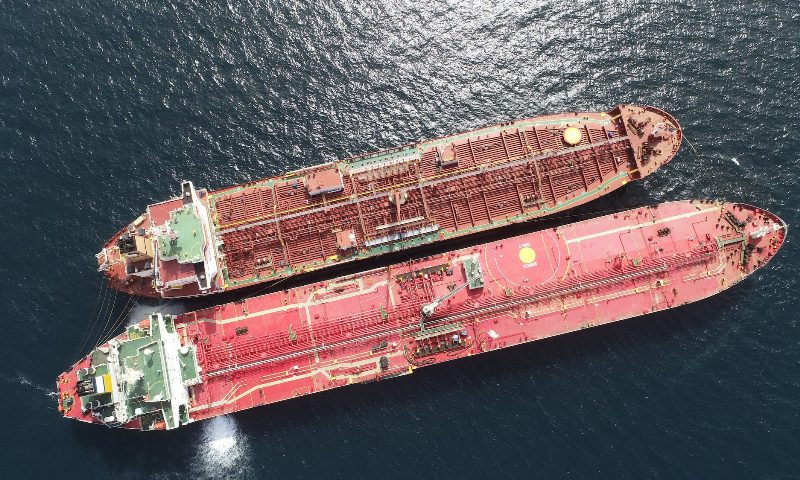
The Baltic and International Maritime Council (BIMCO) has introduced a new standard clause for tanker charterparties, clarifying the allocation of costs and operational responsibilities associated with ship-to-ship (STS) cargo transfers.
The clause places responsibility for the costs and risks of such operations on charterers while safeguarding the master’s overriding authority over vessel safety. It applies to conventional and gas tankers and covers cargo transfers involving both onshore and offshore installations.
Under the new provisions, charterers ordering STS operations will be responsible for arranging the necessary equipment, obtaining regulatory permissions and meeting associated expenses. Shipowners will also be entitled to recover additional insurance premiums and other documented costs arising from these operations, subject to prior approval from charterers.
The clause further allows shipowners to appoint a specialist mooring master or superintendent at the charterer’s expense whenever the vessel’s master considers such assistance necessary.
Importantly, the master’s authority to suspend or stop operations on safety grounds remains unaffected, reinforcing the principle that vessel safety takes precedence over commercial requirements.
The provision was initially developed for BIMCO’s CO2TIME 2026 charterparty, adopted in April to support the emerging liquefied carbon dioxide (LCO₂) shipping market. BIMCO subsequently decided to make the clause available as a standalone provision for broader application across the tanker industry.
BIMCO has clarified that the clause does not cover sanctions compliance. Parties are therefore advised to use it alongside appropriate sanctions clauses where required.
The new provision is expected to provide greater contractual clarity for shipowners and charterers, particularly in defining financial responsibilities, operational requirements and safety-related decision-making during ship-to-ship cargo transfer operations.