
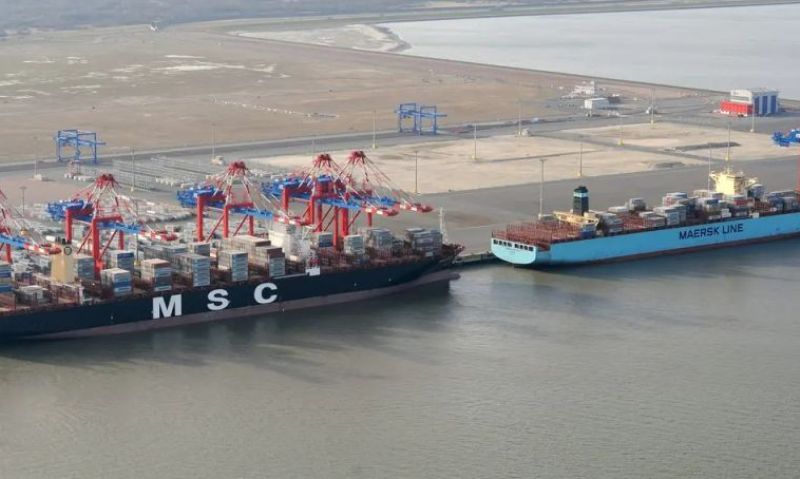
The latest containership ordering activity points to a significant concentration of future vessel capacity among the world’s leading shipping lines, with Maersk, MSC and HMM together accounting for nearly 80% of the total capacity represented by newly reported orders.
According to the November 2026 edition of Dynamar’s DynaLiners Monthly, a total of 83 containerships with a combined capacity of 938,500 TEU were ordered since the previous reporting edition. The figures exclude two additional vessel options, with deliveries scheduled between 2028 and 2031.
The three major carriers account for 35 vessels with a combined capacity of 746,200 TEU, representing approximately 79.5% of the total reported capacity. This highlights the growing emphasis on large-scale containership investments as carriers prepare for future fleet requirements.
Maersk leads with a major megamax programme
Maersk represents the largest newbuilding programme in the latest report, with 24 containerships of 24,000 TEU each contracted at China’s Hudong Zhonghua Shipbuilding. Deliveries are scheduled for 2029 and 2030.
The programme represents 576,000 TEU of capacity, accounting for approximately 61.4% of all the capacity covered in the latest ordering activity.
MSC is also expanding its large-vessel fleet, with three 21,000 TEU containerships listed at Shanghai Waigaoqiao Shipbuilding. The vessels are scheduled for delivery in 2028 and 2029.
South Korean carrier HMM features with eight 13,400 TEU containerships ordered at HD Hyundai, with deliveries expected in 2029. The programme adds 107,200 TEU to its future fleet capacity.
Together, these orders demonstrate the continued preference among major carriers for larger vessels, particularly as they plan long-term fleet deployment across major international trade routes.
Regional carriers continue investing in smaller vessels
While the largest carriers dominate capacity additions, the latest ordering activity also reflects sustained investment in feeder and regional containerships.
Regional Container Lines (RCL) features with six vessels across two size categories, representing a combined capacity of 30,800 TEU. Eastern Pacific is associated with four vessels of 6,000 and 9,000 TEU, while TS Lines has two 11,000 TEU vessels listed.
Korea Marine Transport Company (KMTC) has six 3,100 TEU containerships under construction at Huangpu Wenchong Shipbuilding. Pacific International Lines (PIL), meanwhile, features with seven 1,400 TEU feeder vessels at Huanghai Shipbuilding.
Independent shipowners, including Danaos, Peter Doehle and Global Ship Lease, are also represented in the reported ordering activity.
Vessels below 4,000 TEU account for 34 of the 83 ships listed, but their combined capacity is just 76,900 TEU, or approximately 8.2% of the total.
This reflects two parallel investment strategies in the container shipping industry. Larger vessels offer economies of scale on high-volume routes, while smaller ships remain essential for regional connectivity, feeder networks and services to ports with infrastructure constraints.
Chinese shipyards dominate newbuilding activity
China continues to strengthen its position as the leading centre for containership construction.
Chinese shipyards account for 69 of the 83 vessels covered in Dynamar’s report, representing a combined capacity of 782,900 TEU, or approximately 83.4% of the total.
Hudong Zhonghua Shipbuilding features prominently through the large Maersk programme, while Shanghai Waigaoqiao is associated with MSC’s orders. Huangpu Wenchong is also involved in programmes for regional operators and independent shipowners.
South Korea accounts for eight vessels through HMM’s programme at HD Hyundai, while Japan accounts for four vessels ordered by Eastern Pacific at Imabari Shipbuilding. The construction locations of two 9,200 TEU vessels attributed to RCL remain undisclosed.
The figures underline the importance of Chinese shipbuilding capacity in meeting the industry’s growing demand for new tonnage. They also reflect the ability of major carriers to secure construction slots several years ahead of delivery.
New deliveries coincide with a strong charter market
The increase in future orders comes against a backdrop of continuing vessel deliveries and firm charter market conditions.
Dynamar reports that 21 containerships with a combined capacity of 169,200 TEU were delivered during October 2026. Vessels above 4,000 TEU accounted for approximately 94% of the delivered capacity.
Among the notable deliveries were the 24,200 TEU OOCL Grace, the 16,600 TEU Ever Educe and the 16,100 TEU CMA CGM Lorenzaccio.
The containership charter market also remained strong during the month. The Harpex averaged 2,500 points in October 2026, compared with 2,189 points in October 2025. Braemar’s BOX Index increased from 268.4 to 322.8 over the same period.
All eight vessel categories tracked by the New ConTex recorded higher average charter rates in October compared with the corresponding month last year.
These indicators suggest that demand for chartered tonnage remains firm despite the continued arrival of new vessels. However, prevailing charter market strength does not necessarily indicate how the market will absorb the substantial new capacity scheduled for delivery towards the end of the decade.
Oversupply concerns remain on the horizon
The scale of the latest ordering activity raises questions about the future balance between vessel supply and container cargo demand.
Although larger containerships can deliver lower operating costs per container, these advantages depend heavily on maintaining adequate vessel utilisation. A slowdown in global trade or weaker cargo demand could put pressure on freight rates and fleet deployment.
Changes in shipping routes could also influence the effective availability of vessel capacity. A return to shorter routes, particularly through the Suez Canal, could release additional capacity into the market, potentially coinciding with substantial newbuilding deliveries.
Other factors, including vessel recycling, fleet renewal, sailing speeds and adjustments to shipping networks, will play an important role in determining the actual supply-demand balance.
Importantly, newbuilding orders do not automatically translate into equivalent net fleet growth, as some new vessels will replace older and less efficient tonnage.
Nevertheless, the latest Dynamar figures underline the scale of investment being committed by major carriers and shipowners. With nearly 80% of the reported capacity concentrated among Maersk, MSC and HMM, the next phase of container shipping competition will increasingly depend on how effectively these carriers deploy their expanding fleets.
The challenge will be to match future vessel capacity with cargo demand, trade patterns and network requirements while avoiding excess capacity in an increasingly competitive global container shipping market.