
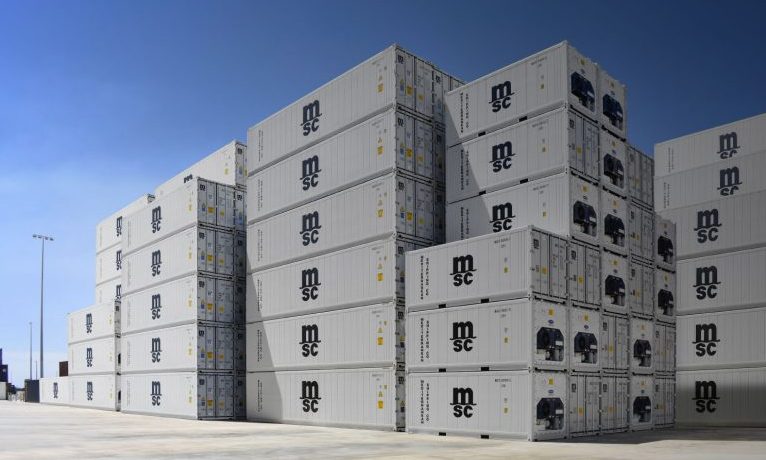
MSC has developed the largest capacity for refrigerated containers, as the Swiss-Italian liner giant strengthens its status as the largest liner operator.
Alphaliner’s report noted that MSC’s fleet has grown nearly 20% over the past year, and its 815 ships have 583,700 reefer plugs installed, representing an increase of almost 18%.
Only Ocean Network Express (ONE) recorded a bigger growth in the number of reefer plugs, at approximately 23%. The pan-Japanese carrier grew its overall fleet by 17.5%.
Meanwhile, South Korean flagship carrier HMM is the only liner operator which reduced its reefer capacity, which dipped by just over 1%, as it reduced its overall fleet by over 2% after redelivering some chartered ships.
Not surprisingly, the ranking of the top 10 carriers by reefer plugs is generally tied to the ranking by total fleet capacity. The one exception is the 10th-ranked ZIM Line, which is the eighth-largest in terms of reefer plugs. The Israeli carrier can deploy over 22% of its fleet to carry reefers.
Alphaliner’s reefer plug count confirms that European carriers have a larger proportion of their total capacity accessible for reefer cargo. The percentage of slots available for plugged-in reefer boxes ranges from 20% for MSC to 23% for Maersk Line, with CMA CGM (22.5%) and Hapag-Lloyd (21.2%) in between. This compares to 15.7%-17.5% for their Asian counterparts, with ONE at the top end and HMM at the low end.