
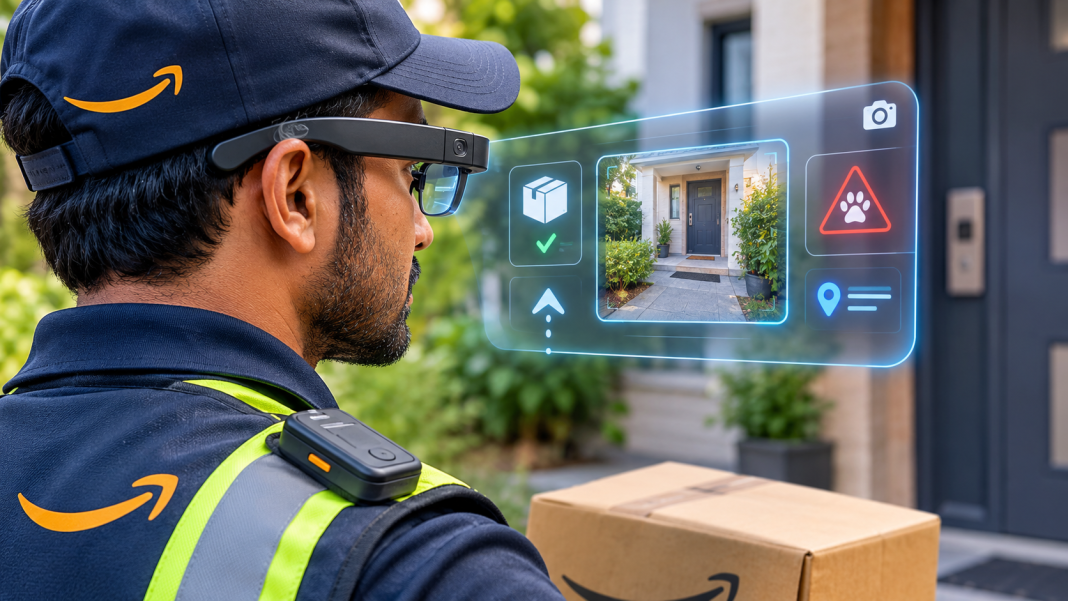
Amazon is scaling up the deployment of its AI-powered smart delivery glasses, with plans to equip 5,000 delivery drivers with the wearable technology this year and expand the fleet to more than 20,000 by the end of 2027.
The update, published by Amazon on October 23, marks a major step in the commercial rollout of the technology first unveiled in October 2025. More than 300 Delivery Service Partners (DSPs) and hundreds of their drivers have participated in trials of the device.
The smart glasses are designed to streamline last-mile delivery operations by reducing drivers’ dependence on handheld scanners and mobile phones. Once a driver parks at a delivery location, a small display inside the lens shows the number of parcels assigned to the stop and confirms each package by scanning its barcode.
While walking to the delivery point, drivers can access navigation directions, customer instructions, entry codes and preferred parcel drop-off locations through the display. The glasses also enable hands-free proof-of-delivery photography.
The technology includes safety and accuracy features such as alerts for potential pets at delivery addresses and warnings when parcels are about to be left at locations that do not match the intended address. Additional features include an LED headlamp, hands-free scanning and proactive address verification. The device supports prescription and light-adjusting lenses.
Following driver feedback, Amazon has redesigned the hardware by moving the computing unit and battery away from the glasses’ frame into a compact controller worn on the delivery vest.
Addressing privacy concerns, Amazon says the camera captures still images rather than video or audio, with faces and vehicle number plates automatically blurred. Images are encrypted, access is restricted to authorised personnel and data is deleted after a short period. Drivers can also disable the camera using a privacy switch, while image capture is suspended during driving. Wearing the glasses remains optional.
However, questions remain over customer privacy. Reports indicate that customers do not currently have an option to opt out of image collection, access the photographs or request their deletion.
The initiative forms part of Amazon’s wider investment in strengthening its last-mile delivery network. In September, the company announced an additional investment of USD 1.9 billion in its Delivery Service Partner programme for 2027. Amazon also reported a reduction of more than 23% in serious crashes and said its total investment in DSPs and their drivers had reached USD 16.7 billion over seven years.
Although Amazon has not announced plans to introduce the smart glasses in India, the technology highlights the growing role of artificial intelligence and wearable devices in last-mile logistics. By improving delivery accuracy, reducing operational errors and simplifying parcel handling, such innovations could help logistics operators lower costs and improve delivery efficiency.