
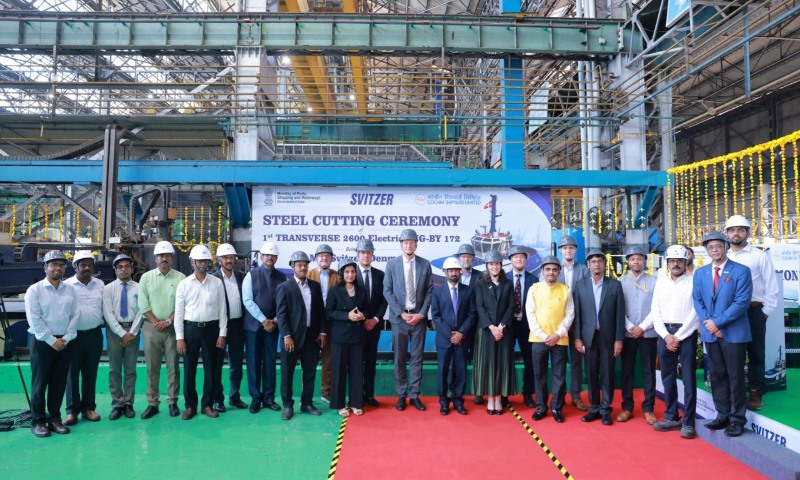
Cochin Shipyard Limited (CSL) has commenced construction of four advanced battery-electric harbour tugs for global towage and marine services provider Svitzer, marking a significant milestone in India’s transition towards greener maritime operations and advanced shipbuilding.
The construction began with a formal steel-cutting ceremony at CSL’s Cochin facility. The four vessels will be Svitzer’s next-generation TRAnsverse 2600e battery-electric tugs, among the most advanced green tugs currently being built globally.
The shipbuilding agreement between CSL and Svitzer was signed in December 2025 and covers a minimum of four vessels. The partnership represents an expansion of Svitzer’s investment in India’s maritime supply chain while strengthening domestic capabilities in electric propulsion and high-specification vessel construction.
Built to Svitzer’s specifications, the tugs are designed to support the ambitions of the Government of India’s Green Tug Transition Programme, as well as the broader objectives of Maritime India Vision 2030 and Maritime Amrit Kaal Vision 2047. The project also aligns with the government’s Make in India initiative by keeping the construction and associated technical capabilities within the country.
The ceremony was attended by Jose V. J., Chairman and Managing Director, Cochin Shipyard Limited, along with senior Svitzer executives, including Kasper Karlsen, Chief Operating Officer, and Deniz Kirdar True, Managing Director – Asia, Middle East and Africa (AMEA), as well as other key stakeholders.
Speaking at the ceremony, Jose V. J. said the partnership with Svitzer was a proud moment for CSL and highlighted the shipyard’s role in advancing maritime decarbonisation.
“It is a proud moment for CSL to partner with Svitzer for the construction of four fully electric TRAnsverse 2600e harbour tugs, and we look forward to strengthening this association further through our shipbuilding capabilities and expertise. CSL will thus be playing a crucial role in advancing the sector’s decarbonisation goals.”
The TRAnsverse 2600e is the battery-electric variant of Svitzer’s next-generation tug platform, developed for demanding harbour operations. The design is intended to provide high manoeuvrability in complex and close-quarter environments and enable operations across different vessel types and sizes, including challenging weather and tidal conditions.
With battery-electric propulsion, the vessels can achieve zero direct emissions during port and terminal towage operations when charged using green electricity, supporting ports in reducing their operational carbon footprint.
Kasper Karlsen, Chief Operating Officer, Svitzer, said the TRAnsverse design is intended to improve operational efficiency and reliability for ports.
“The TRAnsverse is designed to remove constraints in our customers’ operations. It delivers faster and more predictable vessel movements, which protects berth productivity and turnaround times, and it allows a port to get more from the berths, channels and pilots it already has without a proportional increase in fleet size or new infrastructure.”
According to Svitzer, the TRAnsverse platform has already completed more than 3,000 commercial towage jobs, while 18 TRAnsverse vessels are currently under construction worldwide.
Deniz Kirdar True said Svitzer had evaluated shipyards globally before selecting CSL for the project.
“Four fully electric TRAnsverse 2600e tugs now begin construction here in Cochin — among the most advanced green tugs being built anywhere — and the capability to build them stays in India.”
She added that the project reflects Svitzer’s growing investment in India’s maritime supply chain and its commitment to developing advanced green tugs capable of supporting India’s Green Tug Transition Programme and Maritime Amrit Kaal Vision 2047 ambitions.
The project comes at a time when the Government of India is placing greater emphasis on expanding domestic shipbuilding capacity and strengthening the country’s maritime manufacturing ecosystem.
Following measures announced in the Union Budget 2025–26, the government adopted a four-pillar strategy to revitalise the shipbuilding sector. It has subsequently approved a comprehensive package of ₹69,725 crore aimed at strengthening domestic shipbuilding capacity, maritime financing and skilling.
The CSL–Svitzer project adds further momentum to these efforts, combining domestic shipbuilding capability with advanced electric propulsion technology and supporting India’s wider ambition to emerge as a competitive and sustainable global maritime manufacturing hub.