
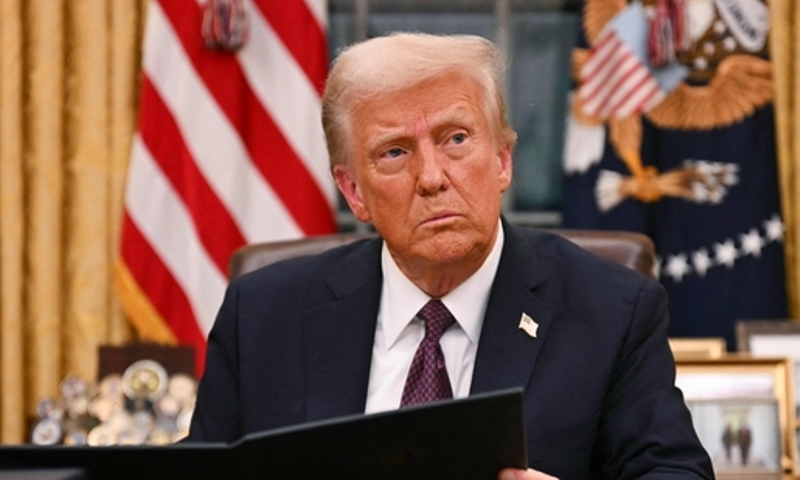
Donald Trump said on Tuesday (April 22, 2025) he had no intention of firing the chair of the U.S. Federal Reserve and signalled a “substantial” lowering of tariffs on China — moves that brought relief to global markets spooked by his aggressive policies.
Mr. Trump’s recent outbursts against Fed chair Jerome Powell had fanned concern that he would oust him, sending jitters through markets. The U.S. President had criticised Mr. Powell for warning that the White House’s sweeping tariffs policy would likely reignite inflation.
“I have no intention of firing him,” Mr. Trump said Tuesday. “I would like to see him be a little more active in terms of his idea to lower interest rates — it’s a perfect time to lower interest rates. If he doesn’t, is it the end? No.”
Since Mr. Trump’s return to the White House in January, the United States has imposed additional tariffs of 145% on many products from China.
These include duties initially imposed over China’s alleged role in the fentanyl supply chain and later over practices Washington deemed unfair.
Beijing has responded with sweeping counter-tariffs of 125% on U.S. goods.
145% tariff ‘very high’: Trump
Mr. Trump acknowledged Tuesday that 145% is a “very high” level, and that this will “come down substantially.”
“They will not be anywhere near that number,” but “it won’t be zero,” the President said.
“Ultimately, they have to make a deal because otherwise, they’re not going to be able to deal in the United States.”
Reciprocal trade embargo
Speaking at a closed-door event hosted by JPMorgan Chase, Treasury Secretary Scott Bessent said Tuesday that the tariffs amounted to a reciprocal trade embargo.
But Mr. Bessent said he expects de-escalation in the near future, according to a person who was in the room.
Such a development should bring markets some relief, he added at the event, which was not open to media.
Wall Street’s major indexes jumped after a news report on Mr. Bessent’s comments at the event, which took place on the sidelines of the International Monetary Fund and World Bank’s Spring Meetings, while Asian markets later rallied in early Wednesday trading.
‘Doing very well’
Mr. Bessent said there is much to be done at the end of the day with Beijing. But he noted the need for fair trade and said that China needs to rebalance its economy.
The Treasury chief stressed that the goal is not to decouple with China, noting that container bookings between both countries have slumped recently as trade tensions heated up.
On Tuesday, White House Press Secretary Karoline Leavitt told reporters that Washington is “doing very well in respect to a potential trade deal with China.”
“The President and the administration are setting the stage for a deal,” she added, noting that “the ball is moving in the right direction.”
She said the feeling is that parties involved want to see a trade deal happen, though China has as of yet not confirmed that it is negotiating with the United States.
As global finance ministers and central bankers converge in Washington this week, all eyes are on the progress of trade talks on the sidelines of the spring meetings as countries grapple with Mr. Trump’s new and wide-ranging tariffs.
China’s foreign minister Wang Yi meanwhile urged Tuesday in phone calls with his British and Austrian counterparts for the U.K. and European Union to work with Beijing on safeguarding international trade.