
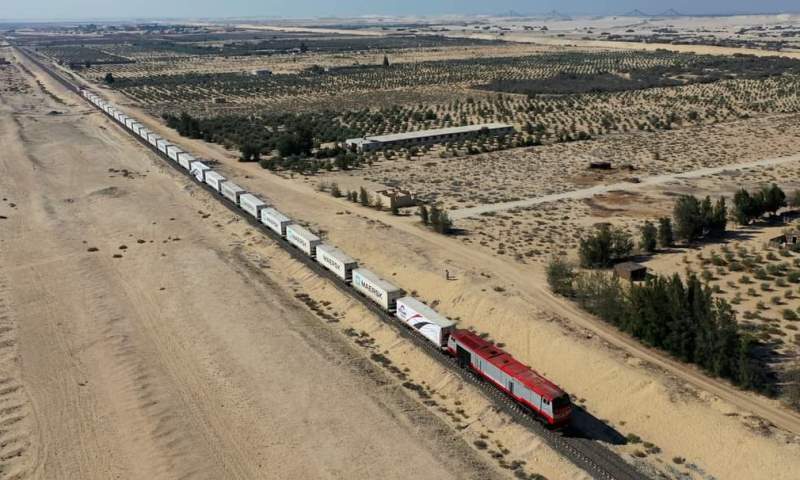
The long-forgotten rail network will be revived in Sinai after decades of suspension. The story began in the late 19th Century when the British laid strategic tracks to protect the Suez Canal. During the First and Second World Wars, the railway became a lifeline, transporting soldiers and supplies. After each conflict, the tracks were left to rust, and Sinai’s potential for a civilian railway system remained unrealized.
Following the October 1973 War (Yom Kippur War), the railway system in the Sinai Peninsula experienced significant disruptions and suspensions, largely due to the ongoing conflict and military operations in the region.
On Monday, a passenger train entered Sinai as part of Egypt’s broader initiative to modernize its transportation network.
The Ministry of Transport Kamel Al-Wazir has initiated a trial run of the Al-Fardan – Bir Al-Abd railway, which spans 100 km across the Sinai Peninsula.
Egypt has embarked on a significant development and reconstruction plan for the Sinai Peninsula, aiming to transform the region and strengthen its infrastructure. One of the key projects is the railway network, including the Fardan – Bir Al-Abd railway line.
This strategic move not only enhances connectivity but also serves as a clear signal against any potential Israeli plans to resettle Palestinians in Sinai, particularly in light of current geopolitical tensions and Israeli aggressions in the region.
By reinforcing Sinai’s infrastructure, Egypt is asserting its sovereignty and preemptively countering any external threats to its territorial integrity.
The new railway is set to boost Sinai’s tourism, industry, and economy, positioning the peninsula as a key player in Egypt’s growth. It’s also a major part of the Suez Canal Economic Zone development, aimed at transforming Sinai into a global hub for trade and tourism.
The Fardan – Bir Al-Abd railway line is 100 kilometres long, and during the past period, a project was implemented for its rehabilitation and development.
The Ministry of Transport has announced that train services on the Fardan – Bir Al-Abd line will operate from 12 to 18 October. The Fardan – Bir Al-Abd railway line extends for 100 kilometres, with the first phase of the Fardan – Bir Al-Abd line stretching from Fardan Station to Balooza over a distance of 60 kilometres. This section has undergone comprehensive rehabilitation, which includes laying a new track and reinstalling the rails that were stolen during periods of insecurity in some areas along the line.
The corridor project extends from the Al-Arish seaport to the Taba land crossing, connected by the Al-Arish – Taba railway line, which is an extension of the Fardan – Bir Al-Abd – Al-Arish line, passing through the heavy industries area in central Sinai. This creates an important route that serves trade, industry, and mining along its path, linking the Mediterranean Sea to the Gulf of Aqaba, according to the Transport Ministry.
The Ministry stated that the corridor also serves the under-construction logistics areas in the Sinai Peninsula, including Al-Tor, Rafah, Al-Awja, Al-Hasana, Al-Naqab, and Taba.