
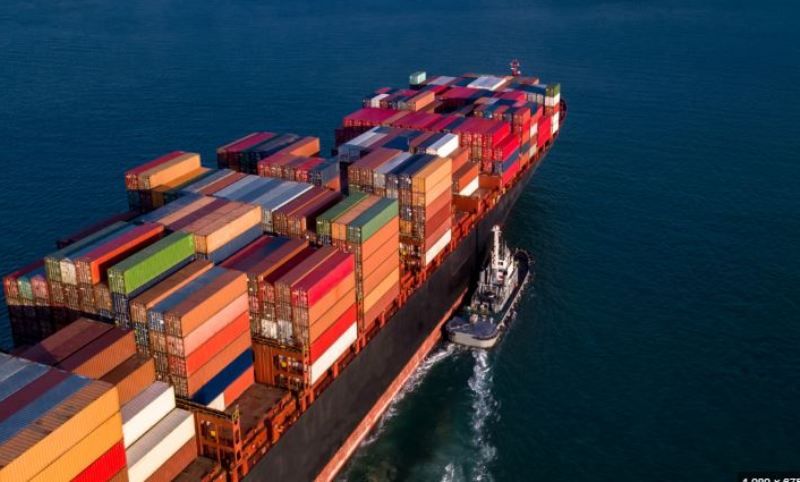
The global containership orderbook has exceeded 15 million TEU and could approach 16 million TEU before the end of 2026, as major carriers prepare another wave of megamax vessel orders, according to Alphaliner.
Around 40 additional large containerships are expected to enter the newbuilding pipeline, involving leading carriers Maersk, Yang Ming, CMA CGM and MSC. While orders from Maersk and Yang Ming are expected shortly, contracts reportedly involving CMA CGM and MSC have yet to be officially confirmed by Alphaliner.
Among the most significant prospective deals is Maersk’s planned return to the 24,000 TEU containership segment. The Danish carrier is reportedly negotiating exclusively with Chinese shipyards for 12 LNG dual-fuel vessels, with options for another 12 ships.
At an estimated cost of $240 million per vessel, the initial order would be valued at approximately $2.88 billion, potentially rising to $5.76 billion if all options are exercised. The vessels would mark Maersk’s entry into the 24,000 TEU category, moving beyond its established twin-engine Triple-E designs. Chinese shipyards are reportedly favoured because of their competitive pricing and available construction slots.
Fleet expansion raises oversupply concerns
Alphaliner’s October Monthly Monitor puts the containership orderbook at 15.12 million TEU, equivalent to 43.9% of the existing trading fleet. Fleet capacity is projected to expand by 9.2% in 2027 and a further 14.4% in 2028, raising concerns about the balance between vessel supply and cargo demand.
The anticipated capacity surge coincides with a gradual return of container services to the Suez Canal route. Sea-Intelligence reported that approximately 60% of deployed Asia-Europe capacity is now operating, or scheduled to operate, through Suez rather than around the Cape of Good Hope. If security conditions remain favourable, further normalisation is expected during the first quarter of 2027.
Shorter voyages through Suez would release effective vessel capacity into the market, potentially intensifying pressure from newbuilding deliveries. Braemar has warned that the combination of returning Suez services and an expanding orderbook is unfavourable for charter rates. Jefferies has similarly cautioned that fleet growth could outpace cargo demand in 2027.
Charter market remains exceptionally tight
Despite the longer-term supply concerns, the charter market continues to demonstrate considerable strength. Alphaliner’s latest survey found that only 0.8% of the global cellular fleet was commercially idle, while charter rates have reached their highest levels in four years.
The scarcity of promptly available vessels continues to support strong earnings, with some large containerships reportedly commanding daily charter rates in six figures.
LNG dual-fuel technology dominates new orders
The ordering boom is also accelerating the industry’s shift towards alternative-fuel propulsion. LNG dual-fuel vessels account for 56% of contracted capacity, compared with 12% for methanol dual-fuel ships. Conventional propulsion represents just under 32% of the orderbook.
Alphaliner recorded 2.3 million TEU of new LNG dual-fuel orders during 2026. The anticipated megamax contracts could add another 1 million TEU, further strengthening LNG’s position as the preferred alternative-fuel option for new containerships. Methanol-fuelled vessel ordering, meanwhile, has almost stalled.
For now, geopolitical disruptions and limited prompt vessel availability continue to underpin strong charter earnings. However, the combination of an expanding orderbook, accelerating deliveries and the potential return of more services through Suez could significantly alter market conditions over the next two years.
Alphaliner has cautioned that the substantial wave of new vessel deliveries will eventually weigh on the market, raising the prospect of greater capacity pressure and weaker charter rates as the industry moves towards 2027 and 2028.