
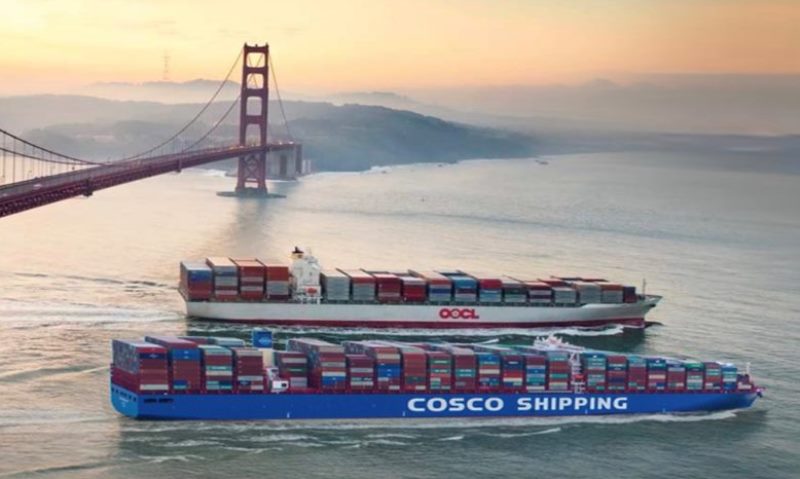
Chinese state-backed shipping majors COSCO and its Hong Kong-listed subsidiary Orient Overseas Container Line (OOCL) could face a combined bill exceeding $2.1bn under the looming US port fee regime, HSBC has warned.
The United States Trade Representative (USTR) is expected to roll out new port charges targeting Chinese-linked tonnage from October 14, although final rules are still awaited. Customs & Border Protection is said to be working on the fee collection system.
HSBC analysis suggests COSCO may incur around $1.5bn in additional costs in 2026—equivalent to 5.3% of projected revenues—while OOCL’s bill could reach $654m, or 7.1% of its forecast revenues. The bank’s model is based on a fee of $600 per feu on a 10,000 teu vessel, more than a quarter of the current Shanghai–US West Coast spot rate.
To mitigate the hit, COSCO and OOCL are expected to lean on Ocean Alliance partners CMA CGM and Evergreen, deploying more Korean- and Japanese-built vessels on the transpacific trade, while Chinese-built tonnage is shifted elsewhere. Carriers are also exploring alternative routings through Mexico, Canada, and Caribbean hubs—moves already visible in newly announced Mexico services.
HSBC cautioned that such network reshuffles could tighten available capacity, with operators holding onto older non-Chinese-built vessels rather than scrapping them. Nearly 93% of the global fleet over 20 years old falls into this category.
OOIL, OOCL’s listed parent, has already acknowledged the “relatively large impact” of the impending charges. The realignment extends beyond containers, with chartering decisions in tanker and dry bulk markets also being reshaped as Chinese-built ships divert to other regions.