
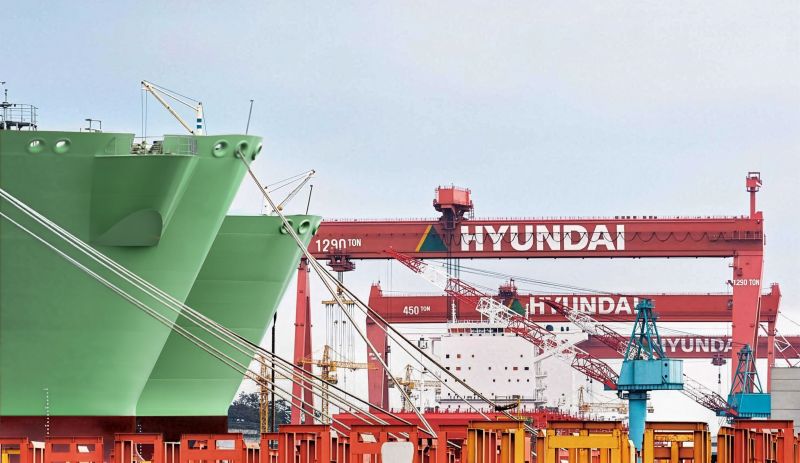
India is advancing plans to establish a proposed USD 4 billion greenfield shipyard at Thoothukudi in Tamil Nadu, following discussions between Union Minister for Ports, Shipping and Waterways Sarbananda Sonowal and HD Hyundai Chairman Chung Ki-sun in Seoul on Wednesday.
According to an official statement, HD Korea Shipbuilding & Offshore Engineering (HD KSOE), the shipbuilding arm of HD Hyundai, reiterated its intention to participate in the project as a primary strategic investor. The discussions took place during Sonowal’s four-day visit to South Korea, aimed at strengthening bilateral cooperation in shipbuilding and the broader maritime sector.
A joint working group (JWG) will oversee the project’s development, while both sides work towards finalising a joint venture structure. The detailed project report (DPR) is expected to be completed within six months, marking a key step towards advancing the proposed shipyard.
“We have a clear mandate to scale up our work together. The MoU we signed on 20 April, 2026 is the bedrock of what we want to build together in Thoothukudi, Tamil Nadu,” Sonowal said.
He described the proposed investment as a significant milestone and reaffirmed the government’s commitment to supporting the project.
The discussions build on the India–Republic of Korea Comprehensive Framework for Partnership in Shipbuilding, Shipping and Maritime Logistics, adopted in April 2026. They also follow a Memorandum of Understanding signed on 20 April 2026 between HD KSOE and NSHIP-TN, on the sidelines of the state visit by South Korean President Lee Jae Myung.
Capacity of 2.5 Million Gross Tonnage
The proposed shipyard is being developed under the Indian government’s Shipbuilding Development Scheme and is envisaged to have an annual shipbuilding capacity of nearly 2.5 million gross tonnage (GT), subject to validation through the DPR.
Once operational, the facility is expected to become India’s largest commercial shipyard, significantly expanding the country’s domestic shipbuilding capacity and strengthening its competitiveness in the global maritime industry.
Beyond infrastructure investment, the collaboration aims to develop a globally competitive shipbuilding ecosystem in India, with a focus on technology transfer, skills development and workforce training.
The project is expected to support India’s broader ambition to strengthen its maritime manufacturing capabilities, reduce dependence on overseas shipbuilding and establish the country as a more competitive destination for commercial ship construction.