
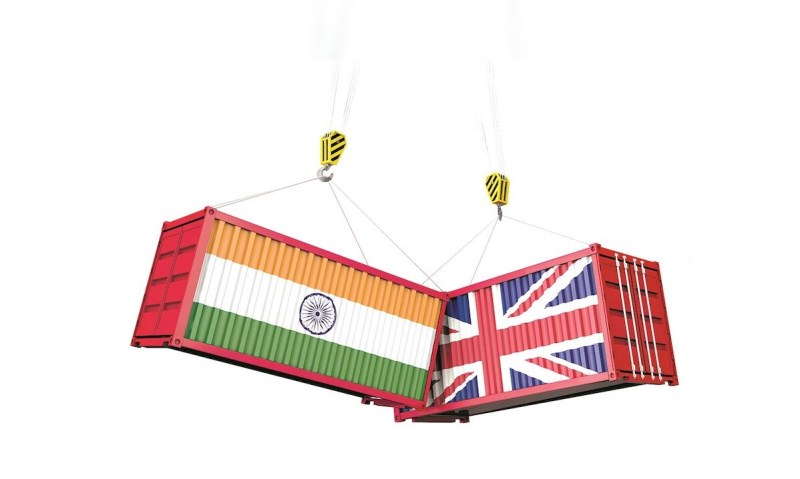
India–UK bilateral trade rose 15% in the first full month under the countries’ free trade agreement (FTA), signalling stronger commercial activity between the two economies. However, British imports grew approximately twice as fast as exports, highlighting an uneven early performance in trade flows following the agreement’s implementation.
The FTA is intended to improve market access, reduce trade barriers and create new opportunities for businesses in both countries. Indian exporters are expected to benefit from improved access to the UK market across sectors such as textiles and apparel, engineering goods, pharmaceuticals, leather products, gems and jewellery, and other manufactured goods.
For British businesses, improved access to the Indian market could support exports of machinery, advanced manufacturing products, chemicals and other goods. The faster growth in British imports during the first full month suggests that the agreement’s early benefits may be emerging at different rates across product categories.
India’s exports to the UK increased 10.35% year-on-year to $1.26 billion in August, while imports from the UK rose 24.23% to $732.95 million. The faster growth in imports narrowed India’s trade surplus with the UK to $527.37 million, compared with $552.13 million a year earlier.
Electrical machinery and telecom instruments lead export growth
Electrical machinery and equipment exports more than doubled to $181.62 million, while telecom instrument shipments climbed 158.44% to $118.80 million. Pharmaceutical exports also increased, reaching $71.29 million.
On the import side, silver emerged as a major contributor, with shipments rising to $113.94 million from $2.80 million in August 2025. This sharp increase accounted for a substantial share of the overall rise in imports from Britain.
The India–UK Comprehensive Economic and Trade Agreement (CETA) came into force on July 15, 2026, providing tariff concessions and improved market access for businesses in both countries. However, the August figures alone do not establish how much of the trade growth resulted directly from the agreement.
Further monthly data will be important in assessing whether the initial growth continues and how the FTA influences India’s exports, imports and trade balance.