
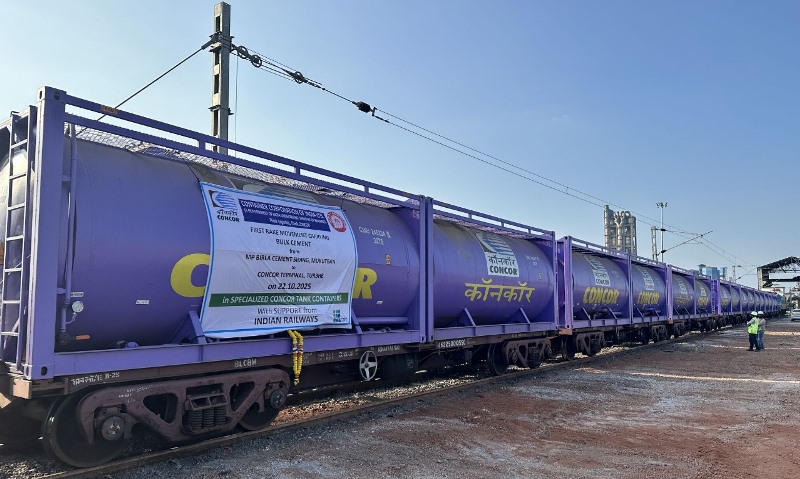
In a major push to strengthen its position in India’s logistics ecosystem, Indian Railways has rolled out a new policy aimed at significantly increasing the share of bulk cement transported by rail. The policy focuses on developing dedicated bulk cement handling terminals and introducing a simplified, industry-friendly freight structure.
Under the new system, Railways will levy a flat rate of ₹0.90 per tonne per kilometre for cement moved in special tank containers designed by Container Corporation of India Ltd (Concor). This shifts the transporter away from its earlier complex slab-based pricing structure, replacing it with a transparent rate based on actual tonnage.
As part of the policy, Railways will also develop bulk cement handling terminals nationwide through public-private partnerships. Poorly patronized assets—such as goods sheds handling fewer than 12 rakes annually, loop lines, and similar infrastructure—may be redeveloped into Gati Shakti Cargo Terminals (GCTs) if proposed by interested bidders. Locations for these terminals will be finalized in consultation with cement manufacturers.
Railway Minister Ashwini Vaishnaw called the policy a “game-changer,” noting that cement is the first commodity to be brought under such a focused logistics solution. “More industries will be identified for reforms and specialized policy measures,” he said.
Industry Welcomes Predictability and Efficiency
Industry experts have lauded the move as a forward-looking step that aligns with the growing demand for bulk cement, particularly in infrastructure projects.
“Most bulk cement movement involves shorter leads of under 300 km, where earlier freight rates made rail movement unviable. This policy is timely and will support faster and more efficient cement distribution,” said Aparna Dutt Sharma, Secretary General of the Cement Manufacturers’ Association.
Bulk cement consumption in major cities has already crossed 50%. Railways highlighted the environmental and cost benefits of transporting cement in specialized wagons from plants to consumption hubs.
India’s cement production for 2024–25 stood at 450 million tonnes, projected to reach 600 million tonnes by 2030. Bulk cement currently accounts for 17% of total production, expected to rise to 30% by 2030. Railways moved 87 million tonnes of cement last fiscal, of which only 7mt was bulk.
Calling the new flat-rate system a major improvement, Arun Kumar Shukla, President & Director of JK Lakshmi Cement Ltd, said: “The shift to a ₹0.90 per GTKM rate and uniform empty-direction charges removes key uncertainties. It greatly improves planning predictability, helps optimise rake utilisation, and strengthens reliability across high-volume rail corridors.”
With India’s infrastructure sector on an expansion path, the policy is expected to significantly enhance logistics efficiency, reduce emissions, and promote multimodal connectivity—positioning Railways as a more competitive option for bulk commodity movement.