
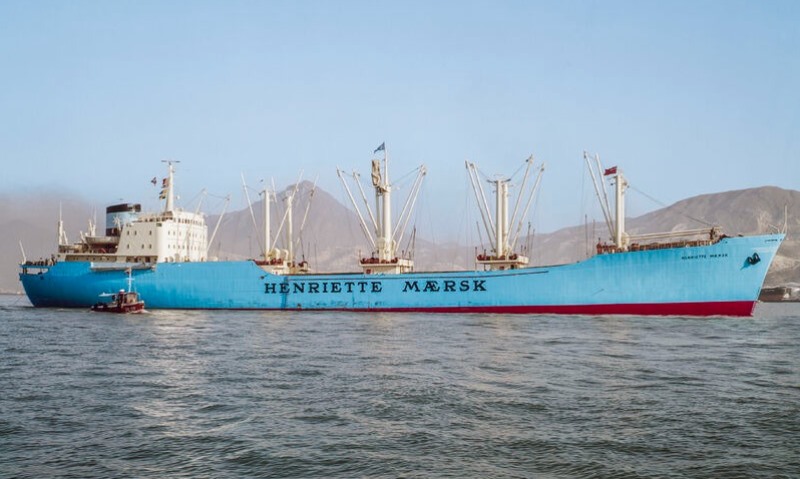
A.P. Moller – Maersk has revisited its rich maritime heritage by highlighting the legacy of Henriette Mærsk, one of the company’s iconic cargo liners that played a significant role in global trade during the 1960s and 1970s.
Built at Helsingør Skibsværft in Denmark in 1962, Henriette Mærsk was the largest vessel ever constructed at the shipyard at the time. The ship was deployed on Maersk’s prestigious “Around the Globe” service, connecting Japan, West Africa, the East and West Coasts of the United States, Southeast Asia, and back to Japan.
Designed as a versatile cargo liner, the vessel featured five cargo holds and dedicated tanks capable of carrying up to 900 tonnes of vegetable oil. Two sister ships, Anette Mærsk and Torben Mærsk, also served in the fleet, supporting Maersk’s expanding global liner network.
Although Henriette Mærsk was sold in 1980, the vessel remains a symbol of an era that laid the foundation for today’s modern ocean shipping industry. Its legacy reflects how decades of innovation, larger vessels, and evolving trade patterns have transformed global maritime logistics.