
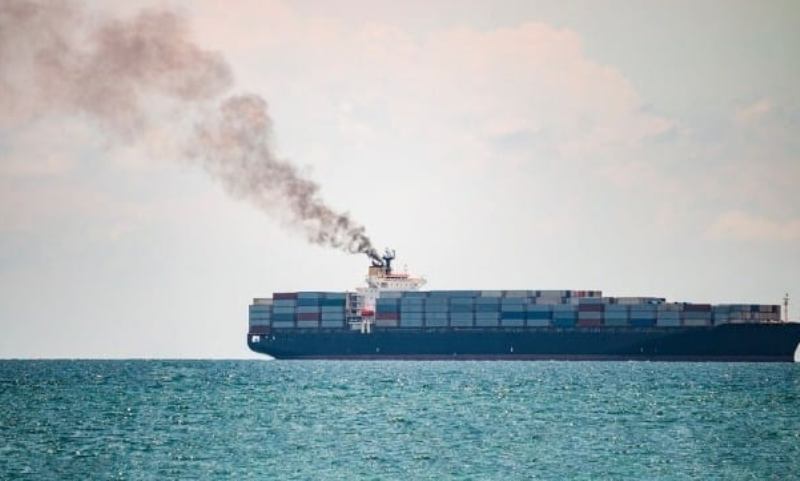
According to the paper “Investigation of a port queuing system on CO2 emissions from container shipping”, the shipping industry is pursuing a diversity of strategies to meet its decarbonization goals, yet inefficiencies like traditional “first-come, first-served” port arrival systems, which encourages vessels to race to port to wait offshore, remain largely unaddressed despite their significant emissions impact.
While the vessel queueing system was originally developed for the purpose of eliminating the bottleneck at the twin ports, Rhodes, McCauley and other collaborators from UC Santa Barbara, NOAA, the California Marine Sanctuary Foundation, the marine exchanges of Alaska and Southern California, and Global Fishing Watch suspected it might have the added benefit of reducing CO2 emissions.
Using a bottom-up emissions model, the researchers have found that after the system’s 2021 implementation, CO2 emissions per voyage dropped by 16–24%. This reduction is largely due to ships traveling at slower, more fuel-efficient speeds now that they no longer need to race to ports and wait offshore.
Developed by Pacific Management Systems, a partnership between the Marine Exchanges of Southern California and Alaska, the system offers a low-cost, quickly implementable model for ports worldwide. Unlike costly technological upgrades, this operational change was rolled out at one of the world’s busiest ports within a month.
Additionally, researchers emphasize that the system’s success depended on digital infrastructure, strong coordination, and the willingness of carriers to adopt new protocols.
They now advocate for wider global adoption of digital queueing systems as a fast, cost-effective step toward reducing port congestion and coastal air pollution.
Integrating digital queueing represents a straightforward win within the broader technology and digital transformation initiatives that ports and logistics companies are already pursuing, offering an easy-to-implement solution that could scale globally as ports modernize and streamline their operations to reduce emissions.
…said Douglas McCauley, Marine ecologist, UC Santa Barbara and Director of the Benioff Ocean Science Laboratory (BOSL).
Research in this paper was conducted by Rachel Rhodes, Benioff Ocean Science Laboratory (BOSL) at UC Santa Barbara, Callie Leiphardt and Hillary Young at UC Santa Barbara; Jessica Morten at the Channel Islands National Marine Sanctuary; Byron Hayes and Jen Dillon at the Marine Exchange of Alaska; Wendy Louttit at the Marine Exchange of Southern California and Mark Powell at Global Fishing Watch.