
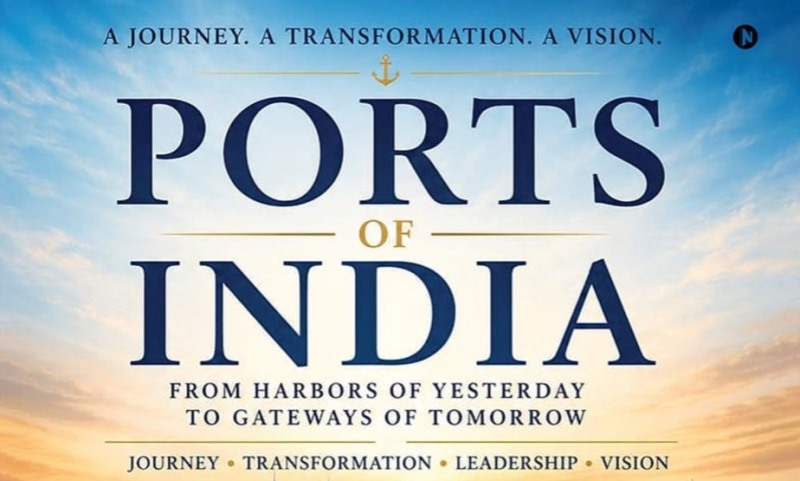
Renowned maritime professional K. Muralidharan has authored Ports of India: A Professional’s Perspective, a practitioner-driven account of the remarkable transformation of India’s port sector over the past four decades and the critical role ports can play in shaping the country’s economic and maritime future.
With nearly four decades of experience spanning port operations, development, finance, public-private partnerships (PPPs), logistics, government administration and maritime education, Muralidharan brings together his professional experiences and insights with the broader story of India’s port-led development.
Muralidharan has held several senior positions in the maritime sector, including Chief Executive Officer of the Andhra Pradesh Maritime Board (APMB) and Managing Director of the Andhra Pradesh Maritime Infrastructure Development Corporation (APMIDC). He has also served as CEO of Karaikal Port, Executive Director of Kakinada Gateway Port and Vice President of Gangavaram Port.
As part of the founding leadership teams, he was involved in the development and operations of Gangavaram Port, Vizag Seaports and Vedanta General Cargo berths. During his tenure with the Andhra Pradesh Maritime Board, he also led development planning for three upcoming greenfield ports in the state.
From Traditional Ports to Modern Maritime Ecosystems
The book traces India’s maritime journey from the anchorage-based, labour-intensive port operations of earlier decades to today’s mechanised, technology-driven and increasingly competitive port ecosystem.
Drawing on first-hand experiences from waterfront operations, project sites, corporate boardrooms and government, Muralidharan examines how mechanisation, private participation, improved road and rail connectivity, deeper drafts, technology and commercial orientation have transformed the performance of Indian ports.
Rather than viewing ports merely as engineering and infrastructure assets, the book presents them as integrated economic ecosystems. It explores cargo development, port business models, project feasibility, master planning, construction, concession agreements, PPP structures, tariffs, financing, operations, productivity, environmental management, ESG, risk management and digital transformation.
According to the author, the success of a port depends not on infrastructure alone but on the effective integration of cargo, connectivity, finance, technology, industry, people and public policy.
PPP and Private Ports Transforming the Sector
A significant focus of the book is the evolution of private participation and PPPs in India’s port sector. It examines how competition and private investment contributed to improvements in productivity, efficiency, customer orientation and infrastructure development.
The book also explores the emergence of ports as catalysts for industrialisation and regional economic development. It argues that India’s next phase of maritime growth should move beyond developing individual ports and focus on creating port-led industrial clusters and integrated maritime economic regions.
AI, Digitalisation and the Port of the Future
Looking towards the future, Ports of India examines how emerging technologies could redefine port operations.
Artificial Intelligence, Digital Twins, sensors, automation, predictive systems and digital connectivity are discussed as important components of the future intelligent port. The book also highlights renewable energy, green fuels, sustainability, climate resilience and maritime innovation as increasingly important factors influencing port development.
Muralidharan envisages future ports becoming deeply integrated with industrial parks, logistics corridors, utilities, research institutions and urban development, thereby creating broader maritime economic ecosystems.
Great Nicobar and Vadhvan: Strategic Maritime Assets
Two dedicated chapters examine the proposed developments at Great Nicobar and Vadhvan, looking beyond their scale as infrastructure projects and considering their potential strategic significance for India’s maritime geography, transhipment capabilities and international supply-chain connectivity.
The book discusses how such projects could influence India’s position in global maritime trade and strengthen the country’s role in regional and international logistics networks.
Lessons for Port Leadership
The concluding sections focus on leadership and the practical responsibilities of a Port CEO. Drawing upon decades of experience in port operations, development, financing and public administration, the author presents lessons on decision-making, project execution, stakeholder management and building commercially successful ports.
The book looks towards 2050, presenting a vision of Indian ports evolving beyond traditional cargo gateways into strategic platforms supporting trade, manufacturing, logistics, technology, energy and national development.
Bridging Theory and Practice
Ports of India: A Professional’s Perspective is intended for port and maritime professionals, policymakers, government officers, investors, infrastructure developers, logistics companies , consultants, students and young professionals.
The author aims to bridge the gap between academic theory and practical experience while transferring institutional knowledge and lessons from one generation of port development to the next.
At its core, the book is both a record of India’s remarkable port transformation and a forward-looking assessment of the country’s maritime potential. Its central message is that ports are not merely infrastructure assets but engines of trade, industry, employment, regional development and national competitiveness.
With India’s ambitions to become a major global manufacturing and trading economy, the book offers a practitioner’s perspective on how a globally competitive port ecosystem can support the country’s next phase of economic growth.
The book, “Ports of India”, is now available on Amazon. https://amzn.in/d/0caoickm