
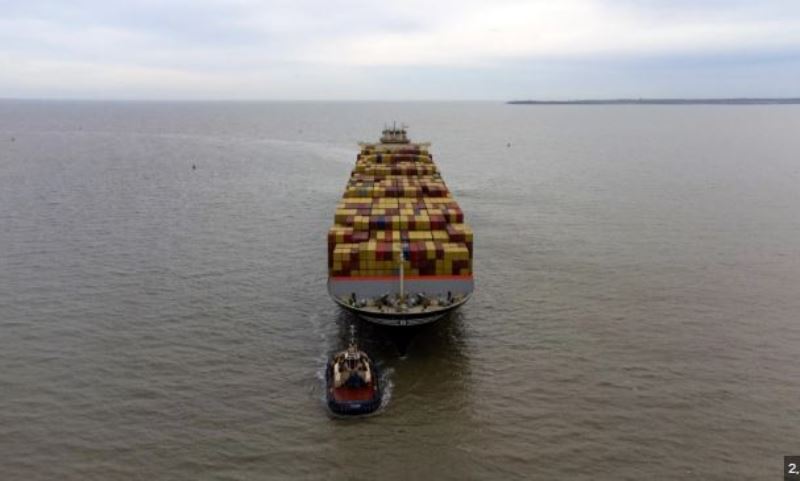
Moscow and Tehran are expanding trade through the Caspian Sea as pressure on Iran’s southern maritime routes intensifies, creating an alternative supply corridor beyond the reach of U.S. naval power.
With traffic through Iran’s Persian Gulf ports facing growing restrictions, cargo is increasingly being redirected through the country’s northern Caspian ports. Four Iranian ports are reportedly operating at high capacity, while Russia’s Port of Olya and Astrakhan have emerged as key hubs for shipments of wheat, animal feed, oil and other essential commodities.
The northern route is closely connected to the 7,200-km International North–South Transport Corridor (INSTC), linking Russia with Iran and onward to the Persian Gulf and India through a combination of maritime, rail and road networks.
Industry estimates suggest that Russia–Iran cargo traffic through the Caspian could reach around 10 million tonnes in 2026, potentially doubling last year’s volume. The increase reflects both immediate rerouting needs and years of investment by Moscow and Tehran in ports, waterways, rail infrastructure and regular shipping services.
Caspian Route Offers Strategic Alternative
The geography of the Caspian Sea provides a significant advantage to the emerging supply chain. The basin is landlocked, and the five Caspian littoral states agreed under the 2018 Convention on the Legal Status of the Caspian Sea that armed forces belonging to non-littoral states should not be present in the region.
As a result, U.S. naval forces operating in the Persian Gulf and surrounding waters cannot directly extend maritime interdiction operations into the Caspian.
Cargo arriving at Russian ports such as Olya can be transported by sea to northern Iran before moving through the country’s road and rail networks. The same infrastructure can also carry Russian exports toward the Persian Gulf and onward to India.
INSTC Gains Greater Importance
The growing traffic is giving renewed importance to the INSTC, which has long been promoted by Russia, Iran and India as an alternative trade corridor connecting Eurasia with the Indian Ocean.
The expansion of Caspian shipping could accelerate investment in terminals, dredging, rail connections, inland logistics facilities and customs infrastructure along the route. What began as an alternative trade pathway is increasingly becoming an important component of Russia–Iran connectivity.
For Moscow and Tehran, the development provides a way to maintain the movement of food, energy products and industrial cargo despite disruption to southern maritime routes.
A Long-Term Logistics Shift
The surge in Caspian traffic also signals a broader shift in regional logistics. Rather than relying exclusively on Iran’s southern ports and the Strait of Hormuz, Russia–Iran trade is developing a multi-modal northern supply chain combining Caspian shipping with rail and road transport.
As capacity expands, a growing share of bilateral trade could move through infrastructure that is geographically insulated from conventional naval pressure in the Persian Gulf.
The development could therefore strengthen the strategic importance of the Caspian Sea and the INSTC, while further integrating Russia, Iran and India into an alternative Eurasian trade network.