
Outer Harbour, container terminal and offshore wind projects to boost capacity, international trade and green energy infrastructure
V.O. Chidambaranar Port Authority (VOC Port) in Thoothukudi is advancing a major maritime infrastructure development programme involving investments of approximately ₹18,437 crore, aimed at expanding container handling capacity, attracting larger vessels and strengthening southern Tamil Nadu’s position in international trade and green energy.
The investment programme comprises the ₹17,167-crore Outer Harbour Development Project, a ₹520-crore container terminal at Berth No. 7 and a proposed ₹750-crore offshore wind terminal. The projects, being pursued through public investment and public-private partnership models, are expected to enhance the port’s capacity and support industrial growth across southern India.
Prime Minister Narendra Modi, during his address in Chennai on October 11, highlighted the Centre’s investment of approximately ₹17,000 crore to develop VOC Port into a world-class mega container port and green energy hub. The proposed Outer Harbour development is expected to enable the port to accommodate ultra-large container vessels, improve international shipping connectivity and strengthen logistics infrastructure for manufacturing and export-oriented industries.
Approved by the Cabinet Committee on Economic Affairs in September, the Outer Harbour project is the centrepiece of the development programme. It envisages deep-water harbour infrastructure and new container terminals to enhance the port’s competitiveness as an international container gateway. The Berth No. 7 project will further augment container handling capacity, while the proposed offshore wind terminal will provide specialised infrastructure for India’s emerging offshore renewable energy sector.
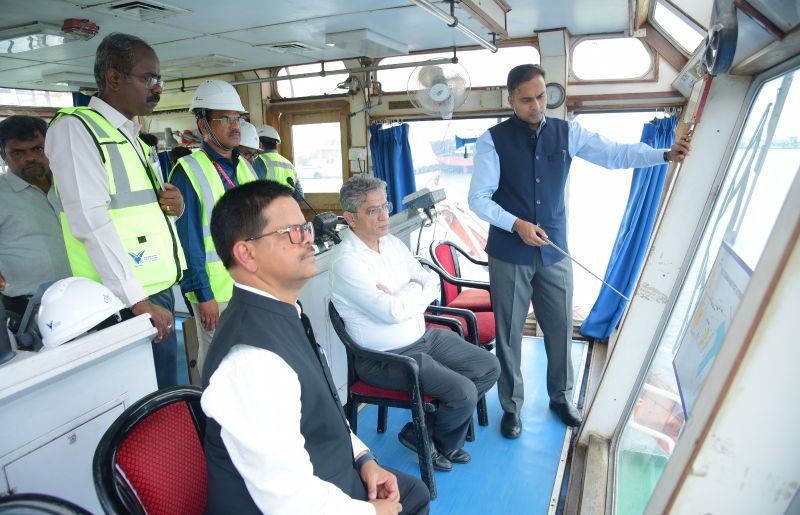
Against this backdrop, Vijay Kumar, IAS, Secretary, Ministry of Ports, Shipping and Waterways, visited VOC Port on October 20 to review key infrastructure projects, operational facilities and green maritime initiatives. He was accompanied by senior port officials during the review.
The Secretary inspected the Green Hydrogen Pilot Plant, wind energy facilities and pilot methanol bunkering and refuelling infrastructure. He also inaugurated shore power facilities, additional mooring infrastructure and other operational improvements aimed at enhancing efficiency and promoting cleaner port operations.
As part of the port’s green mobility initiatives, 13 electric trucks were flagged off at TICT. The visit also included the presentation of awards recognising excellence and outstanding achievements in port operations and development.
Digital transformation initiatives, including the port’s Digital Twin and Port GPT projects, were also reviewed. Discussions with terminal operators, traders and other maritime stakeholders covered port-led industrialisation and the proposed mega greenfield shipbuilding cluster, highlighting the port’s potential to support wider industrial development in the region.
The combined investments are expected to create opportunities for shipping lines, exporters, logistics operators and manufacturing industries by improving vessel access, expanding container capacity and developing specialised infrastructure for renewable energy. The proposed facilities could also strengthen southern Tamil Nadu’s appeal as a destination for fresh industrial investments and export-oriented activities.
The programme aligns with the Union Government’s broader maritime development priorities under the Maritime Amrit Kaal Vision 2047, which seeks to modernise port infrastructure, expand shipping capabilities and enhance India’s competitiveness in global maritime trade.
With major investments planned across deep-water infrastructure, container terminals and green energy logistics, VOC Port is positioning itself for a larger role in India’s international trade and maritime-led industrial growth.