
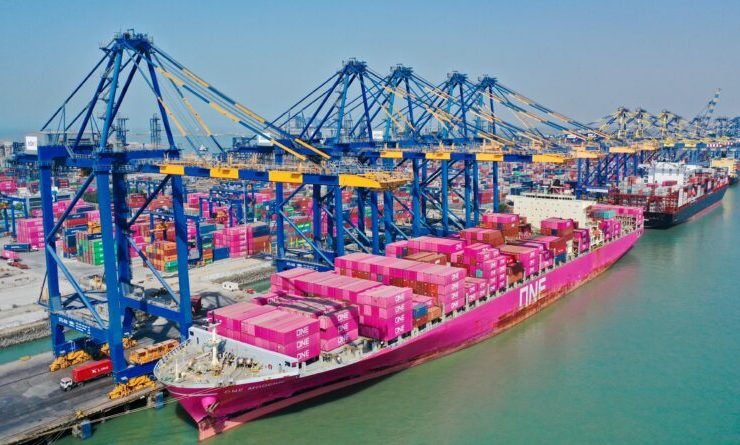
The volume of container movements increased at most Indian ports every year during the first quarter of 2024, according to an analysis by S&P Global Market Intelligence, a financial information and analytics firm.
The biggest increase was registered at Kattupalli port with a yearly increase of 91 percent, as per the report by the financial information and analytics firm.
Oceanside port productivity (port-moves-per-hour) generally improved among ports the firm surveyed. In India, Jawaharlal Nehru Port in Mumbai registered a significant 36 percent year-on-year improvement in performance in the first quarter of 2024.
Berth productivity at the large Indian ports was generally stable year-on-year. Among medium-sized ports, Pipavav port in Gujarat was the highest performer, delivering 125 berth-moves-per-hour (BMPH) during the quarter.
Further, the report noted India managed to reduce import dwell time for containers (-22 percent year-on-year at larger ports; -41 percent year-on-year at medium ports) at a greater rate than counterparts in Southeast Asia and China (-2.9 percent year-on-year at larger ports; +1.6 percent year-on-year at medium ports).
However, export dwell time for containers worsened at Indian ports. Median export dwell time rose to more than four days from 3.5 days the previous year period.
Dwell time is the time a vessel stops to either drop off or pick up goods at ports. This time is crucial in determining the total efficiency.
The dwell time for transshipment almost halved at large Indian ports while at the same time increased by more than 45 percent at counterparts in Southeast Asia and China, the S&P Global Market Intelligence said.
“Import dwell time is the elapsed time in days from offloading from the ship to gate-out while export dwell time is that from gate-in to loading on the ship,” it explained.
Further, the analysis found that Jawaharlal Nehru Port and Mundra Port both saw a significant decrease in vessel waiting time.
Medium-sized Indian ports also experienced lower year-on-year vessel waiting times, with major improvements at Pipavav, Chennai, and Krishnapatnam.