
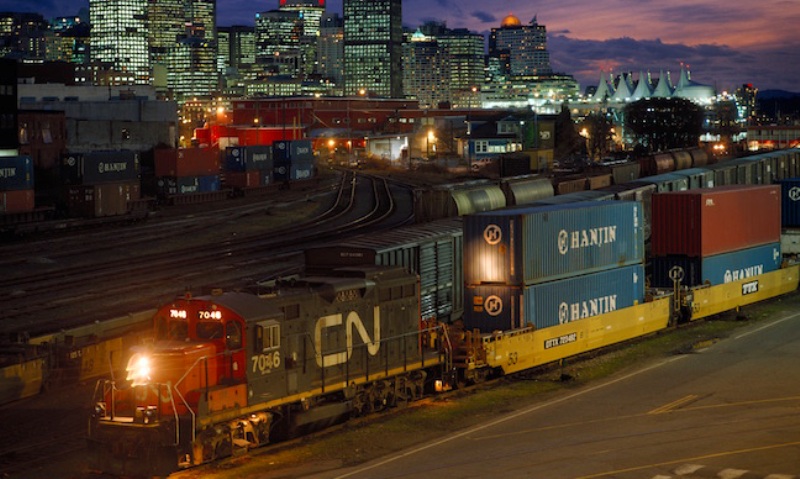
Congestion at Canada’s west coast gateway of Vancouver is set to worsen in the coming weeks due to combination of restricted access to inland rail inks and deteriorating liner schedule reliability as the alliance reshuffle continues.
German carrier Hapag-Lloyd told customers yesterday: “Both CPKC Rail and CN Rail have implemented tiered operating restrictions in response to severe winter weather across Canada. These measures include shorter trains and reduced speeds, which have resulted in minor delays.
“These conditions are expected to last another 10-14 days, resulting in increased Import dwell times,” it added.
The carrier said utilisation at Vancouver’s GCT Delta terminal had reached 102% and vessels were “experiencing berth delays of nine days”, while utilisation at DP World Centerm was at 83%, with berthing delays of between four and nine days.
The rail restrictions have also resulted in rising import container dwell times, now 4.1 days at GCT Delta and 5.9 days at DP World Centerm.
While berth planners at the port are said to be expecting a busy few weeks, a detailed look at the vessels waiting for berths at Vancouver shows other factors at play, explained Destine Ozuygur, head of forecasting and operations at liner database eeSea.
The platform currently shows around 25% of the vessels at the port are awaiting a berth, and she noted that some had been waiting “a very long time”, driving up the overall berth wait average.
These include: Maersk Monte Olivia, waiting for nine days; Marcos V (9 days); MSC Utmost VIII (11 days); Seaspan Falcon (7 days); YM Movement (7 days); YM Plum (6 days); YM Tranquility (10 days); and YM Uniform (8 days)
An outlier is the 13,100 teu MSC Elisa XIII, which is recorded by eeSea as having been waiting for 16 days, but there were gaps in its waiting status that could indicate it was repositioning, and showed how ports could be at the mercy of their liner customers.
“In fairness to the hardworking folks in Vancouver, not all ,but quite a number, of these standout vessels already had extreme delays and unpredictable schedules that the port’s berth planning team and ours alike have been struggling to pin down, because they are part of chronically late alliance services that are in the middle of phasing out,” Ms Ozuygur said.
In the case of the 6,350 teu Maersk-operated Marcos V, for example, being phased-out of the 2M’s transpacific WCNA Loop 5 service, it was some 16 days late at its previous port of call at Prince Rupert, which meant it was unable to berth at Vancouver until it was some 28 days late against the vessel’s proforma schedule.
“A vessel that’s arriving over two weeks behind schedule and has been flip-flopping around with ETAs doesn’t exactly get shuffled to the head of the line at a moment’s notice,” she added.