
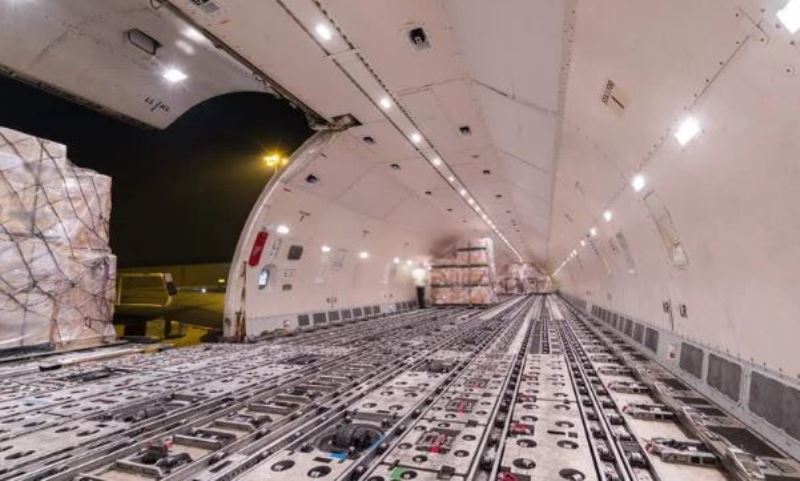
The construction of the first Airbus A350 freighter has taken another step forward with the delivery of the first section 19.
The section 19, which is the aerostructure located aft of the main fuselage barrel and interfaces with the tail of the aircraft, was completed in Getafe and flown to Hamburg onboard one of Airbus’ Beluga aircraft.
The piece is specifically adapted for the A350F and features a protector on its underside to prevent damage during ground operations.
Manuel García, head of A350F engineering, said: “The modification is designed to protect the aircraft from unexpected roll during loading. The challenge was to achieve an airworthy, aerodynamically effective and easy to maintain system, with test-validated structural protection to minimise in-service damage.”
“Cargo aircraft must be held in place by the rear on loading and unloading,” added Carlos Sancho, development programme head. “For this reason, the A350F is fitted with an in-flight adapter that secures the aircraft to the ground, speeding up loading and unloading.”
Airbus said that the fitting of the protector required the re-organisation of the production line.
The airframer explained that alternatives were evaluated to integrate these modifications without affecting the production of passenger A350 aircraft, but in the end, a solution was chosen that maintains the common production line until the last moment, when the freighter sections are diverted to the new station for the necessary modifications.
The implementation included several important milestones, including Process Failure Modes and Effects Analysis (PFMEA), Industrial Process Acceptance Reviews (IPAR) and the First Implementation Check (FIC), which enabled the entire project to be visualised and all modifications to be renewed, ensuring the equipment’s readiness for production.
“This change, although it may seem minor, involves a lot of effort and guarantees the operational safety of the aircraft,” Sancho said.
While production of the new freighter aircraft continues to progress, Airbus announced earlier this year that it would push back the entry-into-service date of its A350 freighter to the second half of 2027, from its earlier expectation of 2026.