
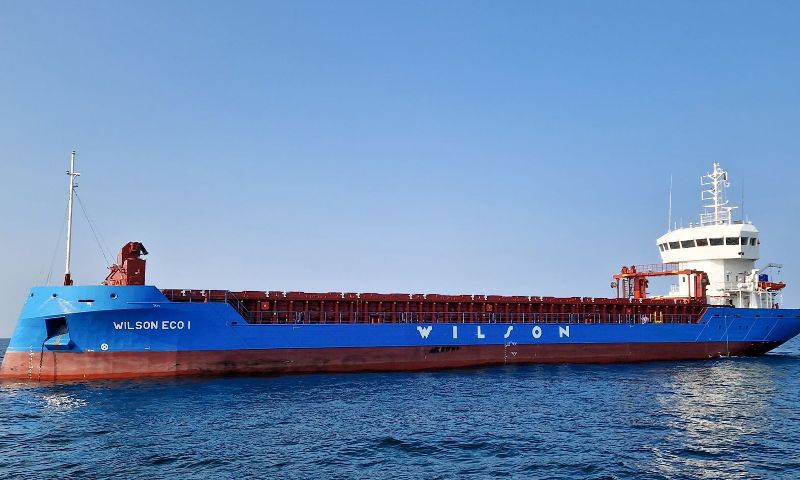
Wilson ASA has taken delivery of WILSON ECO I, the inaugural vessel in its new ECO series and the first of a substantial 14-vessel newbuilding program at Udupi Cochin Shipyard Limited in India. This delivery marks a significant step for the shortsea shipping specialist as it modernises its fleet with a strong focus on sustainability.
Designed by Dutch naval architect Conoship International, the WILSON ECO I adheres to the CIP3800 design, prioritising energy efficiency, operational versatility, and enhanced environmental performance. The vessel features a diesel-electric propulsion system and is equipped for future integration of wind-assisted technology, positioning it for upcoming maritime innovations.
Notably, WILSON ECO I achieves a 30 per cent reduction below the International Maritime Organisation’s (IMO) Energy Efficiency Design Index (EEDI) requirement for 2025. This substantial improvement signifies a considerable decrease in estimated greenhouse gas emissions per unit of transported cargo, underscoring Wilson ASA’s commitment to lower-emission operations.
The ECO series encompasses six 3,800 deadweight tonnage (DWT) vessels, which will be followed by eight 6,300 DWT vessels, with deliveries scheduled from early 2025 through 2028. This program not only expands Wilson ASA’s operational capacity but also actively drives down its environmental footprint, charting a course towards a more sustainable future for the shipping industry.