
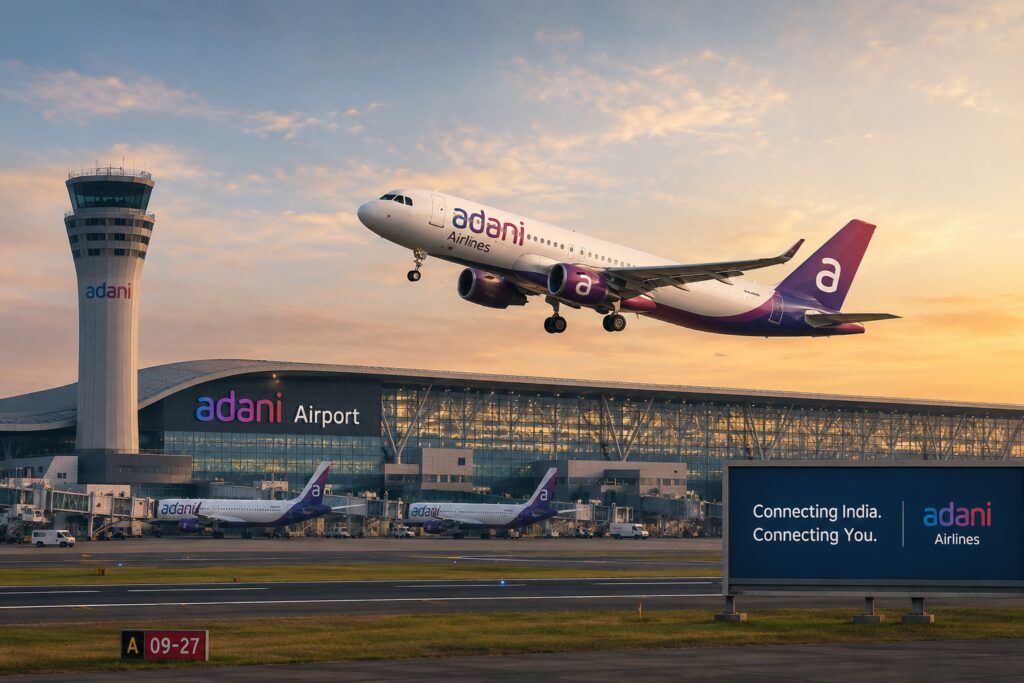
The Adani Group has approached the Central Government seeking relaxation of a long-standing clause that restricts operators of Delhi and Mumbai airports from holding more than a 10% stake in a scheduled airline, a move that could pave the way for the conglomerate to enter India’s aviation sector.
According to government officials and industry executives, the Ministry is examining the proposal and has sought the opinion of Solicitor General Tushar Mehta on the legal feasibility of retrospectively amending the concession agreement clause introduced during the privatisation of Delhi and Mumbai airports in 2006. Any amendment would require approval from the Union Cabinet.
The existing provision prevents operators of India’s two busiest airports from having a controlling stake in an airline. Adani Group currently owns a 74% stake in Mumbai International Airport, while GMR Airports holds a 74% stake in Delhi International Airport.
If the clause is amended, it would remove a key regulatory hurdle for Adani Group to establish its own airline, significantly expanding its footprint in aviation. The conglomerate already has a substantial presence in the sector through airport operations, ground handling services, pilot training, and aircraft maintenance, repair and overhaul (MRO) activities across its network of eight airports.
Government officials indicated that policymakers are keen to encourage greater competition in India’s domestic aviation market, currently dominated by IndiGo and Air India, which together account for nearly 90% of passenger traffic. A well-capitalised new entrant, they believe, could enhance competition and improve consumer choice.
Although Jeet Adani, Director of Adani Airports and son of Gautam Adani, had publicly stated in December that the group had no plans to launch an airline, industry sources say the company’s thinking has evolved alongside its proposed partnership with Brazilian aircraft manufacturer Embraer to establish an aircraft manufacturing facility in India.
According to people familiar with the matter, Adani Group has struggled to secure sufficient customer interest from existing Indian airlines for Embraer aircraft, making a captive airline a potential anchor customer that could improve the commercial viability of the manufacturing project.
A senior Adani executive, however, clarified that no final decision has been taken to launch an airline and that the proposal submitted to the government merely seeks an enabling regulatory framework without current plans to acquire an existing carrier.
The proposal is expected to face resistance from existing airlines, which have expressed concerns over potential conflicts of interest. Industry executives argue that ownership of both airports and an airline could provide an unfair competitive advantage, particularly in the allocation of airport slots, which determine aircraft take-off and landing schedules.
Airline executives also contend that if the government relaxes the restriction for airport operators, it would logically permit airlines such as IndiGo and Air India to acquire stakes in airports, potentially raising fresh competition concerns.
Government officials, however, maintain that safeguards would accompany any amendment. These are expected to include strict arm’s-length governance between airport and airline businesses, prohibition of common key managerial personnel, and restrictions on sharing commercially sensitive information related to slot allocation.
Officials also pointed out that India’s existing slot allocation framework, which allows incumbent airlines retaining at least 80% utilisation of allocated slots to preserve them in subsequent scheduling seasons, already provides adequate protection against discriminatory practices.
While the proposal remains under examination, it signals Adani Group’s growing ambitions in the aviation sector and could potentially reshape the competitive landscape of India’s airline industry if approved.