
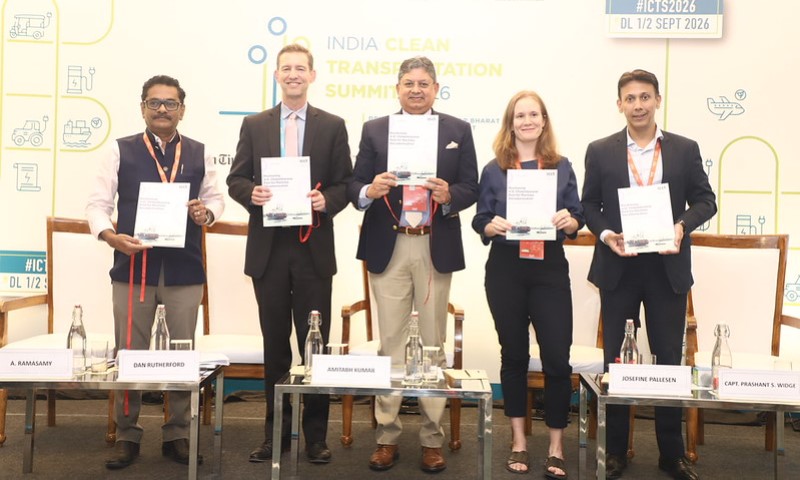
V.O. Chidambaranar Port Authority (VOC Port) has taken another significant step towards advancing India’s green maritime transition with the launch of a new policy brief by the International Council on Clean Transportation (ICCT), titled “Positioning V.O. Chidambaranar Port for Maritime Decarbonization.”
The policy brief was launched at the India Clean Transportation Summit 2026 in New Delhi during a session titled “India’s Maritime Transition in a Net Zero World: Positioning India for the Next Era of Global Shipping.” Ketan Gore, Researcher, ICCT, launched it in the presence of Amitabh Kumar, former Director General of Shipping and Independent Director, The Great Eastern Shipping Company; Josefine Pallesen, Maritime Counsellor, Embassy of Denmark; A. Ramasamy, Chief Mechanical Engineer, VOC Port Authority; and Capt. Prashant S. Widge, Executive Director, Smart Freight Centre – India.
The ICCT assessment identifies VOC Port’s potential to emerge as a green shipping corridor node on the India–Europe trade lane, supported by its strategic location along the East-West maritime route linking the Indian Ocean with the Suez Canal and European ports.
The policy brief recommends strengthening linkages between green-fuel production and maritime offtake, translating the objectives of the Harit Sagar Green Port Guidelines into actionable measures, engaging with the Global Maritime Forum’s green shipping corridor network, and developing reliable supply pathways for green fuels to the shipping sector.
It also highlights opportunities for VOC Port to engage with EU-connected shipping operators, strengthen green-fuel offtake and bunkering arrangements, and establish partnerships with international ports and other stakeholders to support the development of a green shipping corridor.
The ICCT assessment is among the early independent studies focusing specifically on the green-fuel readiness of an individual Indian port. It provides strategic direction for integrating clean-fuel production with maritime demand and emerging international green shipping networks.
VOC Port has already established a strong foundation for green maritime initiatives. Designated as one of India’s Green Hydrogen Hubs under the National Green Hydrogen Mission, the port was the first Indian port to produce green hydrogen. Its initiatives include a 10 Nm³/hr green hydrogen pilot project, providing operational experience in renewable energy generation, electrolysis, hydrogen storage and fuel-cell technologies.
The port is also nearing completion of 2 × 750 cubic metres of green methanol storage capacity to support future bunkering requirements and is developing a dedicated green ammonia berth for handling and future bunkering of green ammonia.
Further initiatives include extending shore-to-ship power across all berths, procuring green tugs, establishing a 3 MW green hydrogen production plant, a 2 MW ground-mounted solar power plant, an 8 MW wind farm integrated with a 5 MWh Battery Energy Storage System, and an additional 9 MW wind power farm.
VOC Port is also emerging as a major hub for green-fuel investments. Around 501 acres have been allotted to green-fuel developers, involving stated investments of approximately ₹41,860 crore. The port handled around 1.45 lakh tonnes of liquid ammonia in 2024-25, adding to its experience in handling ammonia-related cargo.
Welcoming the ICCT assessment, Susanta Kumar Purohit, IRSEE, Chairperson, VOC Port Authority, said the study provides valuable strategic direction for strengthening the port’s green-fuel ecosystem and enhancing its role in maritime decarbonisation.
The port’s initiatives are being pursued in line with the Harit Sagar Green Port Guidelines of the Ministry of Ports, Shipping and Waterways and India’s broader climate commitments, including the national objective of achieving Net Zero emissions by 2070.